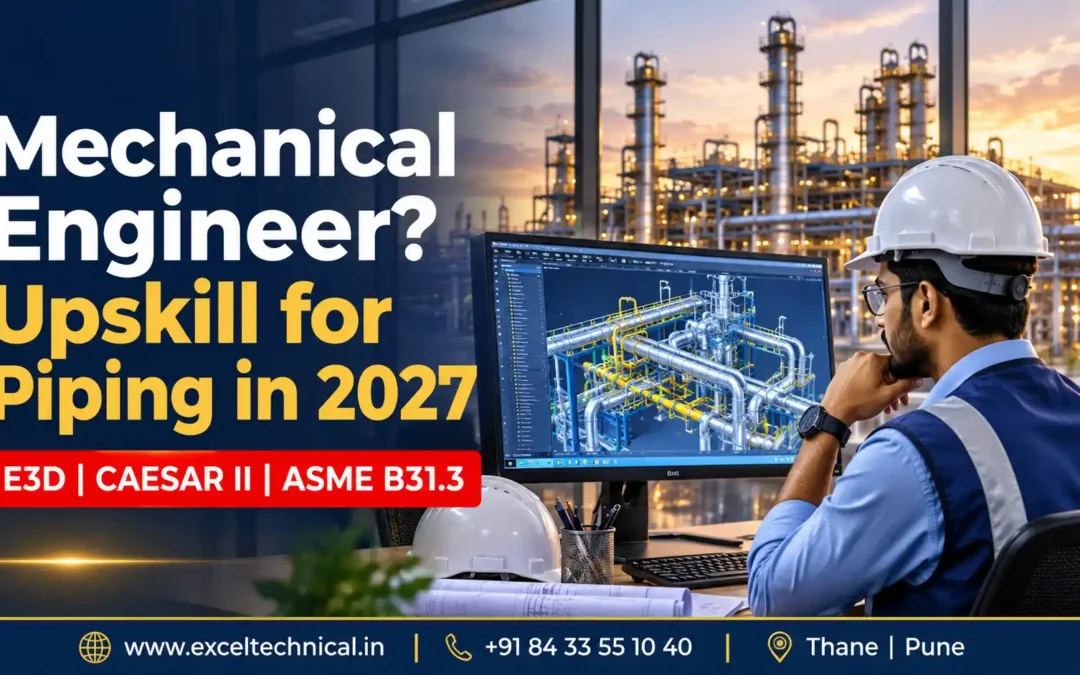
Quick answer: Yes. For mechanical engineering graduates who want a core-industry career, piping engineering upskilling is worth it in 2027. EPC, Oil & Gas and refinery projects hire people who can read P&IDs, apply ASME B31.3 and build clash-free 3D models in E3D or SP3D. A degree builds theory. Upskilling builds execution.
You studied thermodynamics, fluid mechanics and machine design. You cleared every semester. Then an EPC recruiter asks one simple question: “Can you read a P&ID?”
The silence that follows is the real problem. It isn’t a lack of intelligence. Most mechanical syllabi never reach the stage where a pipe is routed, supported, stress-checked and issued as a drawing. That stage is where the jobs are.
Why a mechanical degree alone often isn’t enough
Colleges teach you why a pipe carries fluid under pressure. EPC companies pay you to decide where that pipe goes, how it is supported, and whether it clashes with steel, cable trays or another line.
Recruiters keep pointing out the same gaps in fresh graduates:
- No exposure to industry software such as AVEVA E3D, SP3D or AutoCAD Plant 3D
- No idea how a P&ID becomes a 3D model and then an isometric
- No familiarity with piping codes, standards and material specifications
- No view of how a project moves from engineering to construction
Upskilling closes that gap. It doesn’t replace your degree. It makes your degree employable.
What does a piping engineer actually do?
Think of a refinery or process plant as a city, and piping as its road and water network. A piping engineer plans that network so it is safe, buildable and easy to maintain.
A typical project day involves:
- Reading P&IDs and Process Flow Diagrams (PFD) to understand process intent
- Applying the Piping Material Specification (PMS) to select pipes, flanges and valves
- Handling pipe routing and building the 3D model in E3D, SP3D or Plant 3D
- Running model reviews in Navisworks to remove clashes
- Generating piping isometric drawings for fabrication
- Coordinating with the stress team, who use CAESAR II to check flexibility and loads under ASME B31.3
None of this is exotic. It is learnable in a structured, project-based programme such as a PG Diploma in Piping Engineering.
Why 2027 looks like a good time to start
Nobody can promise a job market, but several trends point the same way:
- Brownfield and revamp work: Ageing plants need modification, which needs engineers who can work from existing layouts.
- Energy transition projects: LNG, green hydrogen and cleaner fuels all need process piping.
- Modular and prefabricated construction: Skid-based work raises demand for accurate 3D models and isometrics.
- Digital twins: Companies increasingly expect engineers who are comfortable with intelligent 3D data, not just 2D lines.
- Gulf and international projects: Overseas EPC work keeps recruiting trained piping professionals.
The common thread is execution-ready talent, and companies keep saying they can’t find enough of it.
Skills and software to build
| Area | What to learn |
|---|---|
| Process inputs | P&IDs, PFDs, PMS, line lists, plot plans |
| Codes and standards | ASME B31.3 fundamentals, piping codes and standards |
| 3D design | AVEVA E3D, SP3D, AutoCAD Plant 3D |
| Layout | AutoCAD piping layout, equipment layout, pipe routing |
| Stress basics | CAESAR II |
| Review | Navisworks, clash-free routing |
| Deliverables | Isometrics, MTOs, piping drawings |
Don’t try to learn everything at once. Start with P&IDs and layout logic, add one 3D tool, then build depth.
Career path and pay: an honest view
Typical entry roles include Trainee Engineer, Piping Draftsman and E3D Piping Designer. From there, people move to Piping Design Engineer and later Piping Project Engineer.
| Level | Indicative range (India) |
|---|---|
| Trainee / Draftsman | ₹2.5 – 4.5 LPA |
| Designer / Design Engineer (2–5 yrs) | ₹5 – 10 LPA |
| Senior / Lead (8+ yrs) | ₹12 LPA and above |
These ranges are indicative and vary by company, city and skill. Check live job listings before you plan around a number.
Growth comes from software depth, code knowledge and project exposure, not just years served.
Who benefits most from upskilling
It suits you if you are:
- A mechanical or chemical engineering student or fresher with a degree but no industry skills
- Someone whose applications get rejected for “lack of practical exposure”
- A job seeker targeting Oil & Gas, EPC, process plants or overseas roles
- Willing to practise on real project-style assignments, not just attend lectures
It is probably not the right move if you want a purely IT career, or if you aren’t ready to put in hands-on practice hours.
How to choose a piping course: a checklist
Before paying any fee, ask:
- Does the curriculum use real project inputs (P&IDs, PMS), not only software tutorials?
- Does it teach the industry software EPC companies actually use?
- Is the trainer an active industry practitioner?
- Can the institute show named, verifiable placement outcomes with company and role?
- What does “placement support” include: resume work, interview preparation, company connects?
A course that can’t answer these clearly deserves a second look.
How ETI’s PGDPE approaches this
Excel Technical Institute’s Post Graduate Diploma in Piping Engineering (PGDPE) is built around the execution gap. Learners work from real-world inputs through to deliverables. The curriculum covers process piping design, piping components, piping material specification and isometric drawings, with training across AutoCAD, E3D, CAESAR II, SP3D, Plant 3D and Navisworks.
The programme is led by Mr. Prathamesh Sawant, Managing Director of ETI and a piping industry expert with 10+ years of experience. It comes with 100% placement support and structured career guidance, including a PG Diploma in Piping Engineering with Placement pathway for serious job seekers.
Looking for a local option? Excel Technical Institute is a Piping Engineering Training Institute in Thane and also runs the PG Diploma in Piping Engineering in Pune.
Frequently asked questions
Is piping engineering a good career for mechanical engineers in India?
Yes. It applies core mechanical concepts directly and offers clear roles across EPC, Oil & Gas and process industries.
Can freshers get into piping design without experience?
Yes, usually through Trainee Engineer, Draftsman or Designer roles, provided they have working knowledge of the software and drawings.
Which software should I learn first?
Start with AutoCAD piping layout fundamentals, then move to E3D or SP3D, whichever your target employers use.
Is CAESAR II necessary?
It is essential for stress analysis roles and a valuable add-on for design roles.
How long does upskilling take?
It depends on the programme. A structured diploma typically takes a few months of focused, practice-heavy learning.
Where can I do a piping engineering diploma course in Thane or Pune?
Excel Technical Institute offers its Piping Engineering Diploma Course in Thane and Pune, with classroom training and placement support.
Your next step
If your degree is ready but your skill set isn’t, 2027 is a sensible year to fix that. Talk to our counsellors, check the syllabus and see our placement outcomes before you decide.
📞 +91 84 33 55 10 40 | 🌐 www.exceltechnical.in | 📍 Thane | Pune