
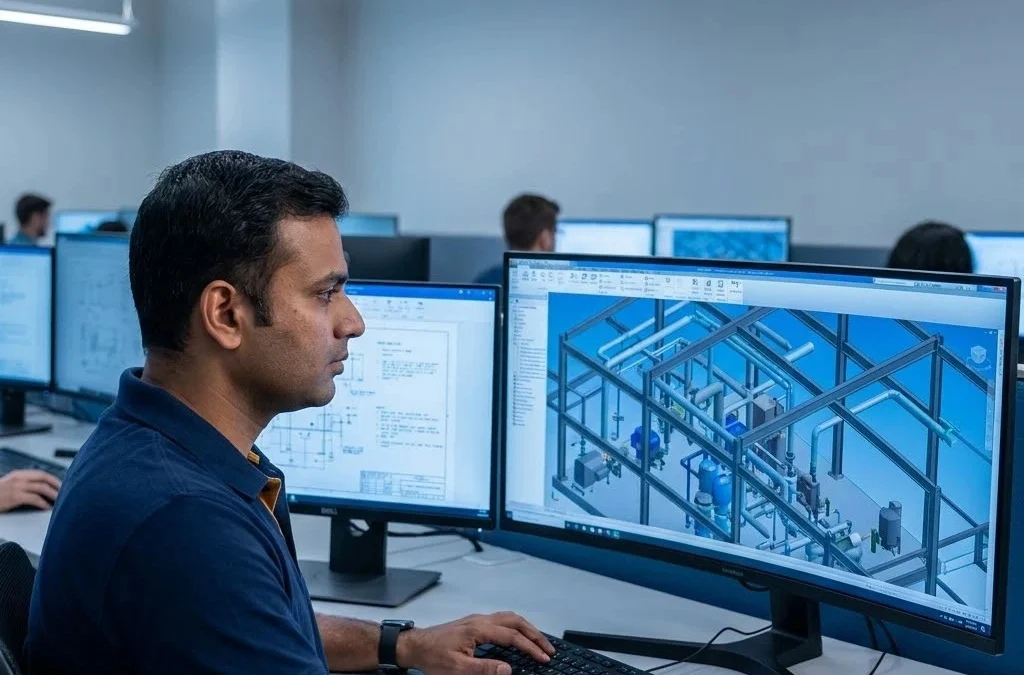
Scroll through piping and plant design job postings from major EPC contractors right now, and one thing stands out. SmartPlant 3D — SP3D — keeps showing up not as a “nice to have,” but as a baseline requirement. Large engineering firms running big industrial and infrastructure projects, including names like L&T, Worley, Jacobs, and Petrofac, are among the companies known to run their plant design work on SP3D, and that shift shows up directly in what they screen for when hiring.
If you’re a piping or plant design engineer in or around Mumbai wondering which software skill is actually worth your time right now, this is it.
What Is SP3D Training, and Why Does It Matter So Much?
SP3D — SmartPlant 3D — is a rule-based, specification-driven plant design platform. Unlike traditional 2D AutoCAD drafting, where you draw each line manually, SP3D lets you build an intelligent 3D model where piping, equipment, and structure follow project specifications automatically, and the software checks for clashes and interferences as you go.
That’s the core reason SP3D has taken over large EPC projects that used to run entirely on 2D AutoCAD. A 2D drawing doesn’t know when a pipe is about to collide with a structural beam three floors away. An SP3D model does, and it flags that conflict before it ever becomes an expensive fabrication mistake.
Actionable takeaway: If your current skill set stops at 2D AutoCAD, you’re positioned for smaller or older projects. SP3D is what opens the door to large-scale EPC work specifically.
Section 1: What Real SP3D Training Actually Covers
SP3D training isn’t just learning where the buttons are. A properly structured programme teaches you to build and manage a working plant model the way projects actually use it — routing piping through a modelled environment, placing and configuring equipment against a catalog, and generating the drawings a project team actually issues.
Core areas real SP3D training covers:
- Navigating the SP3D environment and setting up a project correctly
- Catalog and specification management — how the software enforces project rules automatically
- Equipment modeling and placement within a plant layout
- Piping routing through equipment, structure, and pipe racks
- Clash detection and interference checking across disciplines
- Isometric and orthographic drawing extraction directly from the model
Section 2: What You Actually Learn in a Real SP3D Course
Here’s where a lot of people misjudge SP3D training — they assume it’s just software navigation. It isn’t. A real SP3D course teaches you to produce actual project deliverables, not just click through menus.
What a properly built SP3D course teaches you to actually do:
- Pipe routing — connecting equipment through a plant model while respecting clearance, access, and specification rules
- Equipment modeling — placing vessels, pumps, and other equipment using catalog-driven data instead of freehand drawing
- Nozzle orientation — correctly configuring equipment connection points so piping routes align properly, a detail that trips up a lot of self-taught learners
- MTO generation — producing an accurate material take-off directly from the model, one of the deliverables project teams actually depend on
Actionable takeaway: When evaluating any SP3D course, ask specifically whether it covers nozzle orientation and MTO generation. If it only covers basic navigation and routing, you’re getting a fraction of what the software — and the job — actually requires.
Section 3: SP3D Software Training vs. Teaching Yourself Online
It’s tempting to think you can pick up SP3D software training from free YouTube tutorials the way you might learn a simpler tool. In practice, this rarely works, for a few specific reasons.
| Factor | Self-Learning (YouTube) | Structured SP3D Training |
| Software access | Often unlicensed or trial versions with limited features | Full licensed workstations |
| Specification catalogs | Rarely included or realistic | Real project-based catalog data |
| Project scenarios | Generic, simplified demos | Actual plot plans and equipment layouts |
| Feedback on mistakes | None | Direct correction from instructors |
| Deliverable practice | Rare | Isometrics, MTOs, and clash reports built hands-on |
SP3D itself is expensive, licensed software — most self-learners never even get real access to it, let alone the specification catalogs that make the “rule-based” part of rule-based modeling actually work. Without those, you’re watching someone else use the software, not learning to use it yourself.
Section 4: SP3D Course in Mumbai — Why ETI Thane Is the Practical Choice
If you’re searching for an SP3D course in Mumbai specifically, ETI’s Thane campus is worth strong consideration — it sits roughly 20 minutes from Mumbai, making it genuinely commutable for professionals working in or around the city, while offering something most Mumbai-based options don’t: fully licensed SP3D workstations and direct placement connections into the Mumbai and Thane EPC employer network.
The SmartPlant 3D Course at ETI is built as an advanced specialization, assuming you already have piping or plant design fundamentals, and covers equipment modeling, piping routing, clash detection, and drawing extraction using real project scenarios rather than simplified demos.
Actionable takeaway: Location matters more than people expect for hands-on software training — a licensed lab you can actually get to consistently beats a remote or self-paced option where “hands-on” ends up meaning trial software on your own laptop.
Section 5: SP3D vs. AVEVA E3D — Which Should You Learn First?
Both SP3D and AVEVA E3D are rule-based, specification-driven plant design platforms, and the honest answer to “which one” depends entirely on where you want to work, not which is objectively “better.”
- SP3D remains deeply established at many large, longer-running EPC firms and legacy project environments
- AVEVA E3D is gaining ground on newer builds and multi-disciplinary projects that prioritize a fully shared model across piping, structure, and equipment teams
Actionable takeaway: If you already have a target employer in mind, find out which platform their projects actually run on before deciding — training in the “wrong” one for your goal just means relearning it later. If you’re undecided, SP3D remains the safer first choice given how entrenched it still is across large-scale EPC work.
Ready to Actually Learn SP3D — Not Just Watch It Being Used?
SP3D isn’t a skill you can bluff your way through in an interview, and it isn’t one you can reliably self-teach from free tutorials either. If EPC job listings keep asking for it and you don’t have it yet, that gap isn’t closing on its own.
Train on licensed SP3D at ETI Thane — Book your free demo class today.
Frequently Asked Questions
1. What are the SP3D course fees at ETI?
Course fees vary depending on your background and whether you’re combining SP3D training with other specializations. The most accurate, current fee structure is shared directly during a free demo class or consultation with a course advisor.
2. Do I need prior piping or plant design experience to join an SP3D course?
Yes. SP3D training is an advanced specialization — you should already understand piping fundamentals or plant design basics from a prior course or project experience. SP3D itself is taught from scratch, but the underlying engineering concepts are assumed going in.
3. How long does it typically take to learn SP3D properly?
A structured SP3D course typically runs around one month of focused, hands-on training. Reaching genuine project-ready fluency after that depends on how much real modeling practice you get, but a well-built course compresses this significantly compared to self-teaching.
4. Is SP3D training available specifically for professionals working in Mumbai?
Yes. ETI’s Thane campus is roughly 20 minutes from Mumbai, making it a practical, commutable option for working professionals, with licensed SP3D workstations and placement connections into the wider Mumbai EPC network.
5. Should I learn SP3D or AVEVA E3D first if I’m not sure which employer I’ll target?
If you’re genuinely undecided, SP3D is generally the safer starting point given how entrenched it remains across large, established EPC firms — though it’s worth checking which platform your specific target employers actually use before committing.