
AVEVA E3D Course
➲ Coordinate piping, structures, equipment, and cable trays inside one intelligent 3D model, exactly as they exist on real EPC projects.
➲ Build and manage a shared multidisciplinary model using AVEVA E3D, the specific plant design software standardized on major EPC projects.
➲ Master the workflow of getting every engineering discipline working in the same model at the exact same time.
➲ Progress from catalog-driven equipment modeling through piping and structural design, all the way to running advanced clash detection.
➲ Prepare your project for formal design review and learn to coordinate a complete multidisciplinary model rather than just modeling in isolation.
Course Details
Duration
1 month
Training Mode
Classroom + Software Labs
Location
ETI Thane & Pune
What You will Get?
Certification
Who Should Enroll
This course suits engineers who’ve already completed foundational piping or plant design training, or who have hands-on project experience in piping, structural, or equipment layout work, and now want to specialise in AVEVA E3D specifically. It also works for SmartPlant 3D users moving to E3D for a specific project or employer requirement. Basic plant design knowledge is assumed; the software itself is taught from scratch, module by module.
If you don’t yet have that foundation, our PG Diploma in Piping Engineering is the recommended starting point before joining this course.
Skills You’ll Master
You’ll model piping, structural steel, and cable tray runs within the same shared model, learn pipe rack modeling that accounts for all three disciplines at once, work with catalog and specification management, perform clash detection, resolve model conflicts, and prepare the model for engineering review.
Let's Learn, Innovate & Evolve with ETI
Detailed Curriculum
Introducation
The course builds in the order a real multidisciplinary model actually comes together — structure and equipment first, routing next, coordination and review last.
Module 1 — AVEVA E3D Fundamentals and Project Setup
- Introduction to AVEVA E3D and the unified engineering platform
- Navigating the E3D environment and setting up a project
- Understanding catalog and specification management basics
Module 2 — Catalog-Driven Equipment Modeling
- Placing equipment using catalog-driven equipment modeling
- Configuring components against project specifications
- Positioning equipment correctly within the plant layout
Module 3 — Structural and Pipe Rack Modeling
- Building structural steel and platform models
- Pipe rack modeling that accounts for piping, cable tray, and structural clearance together
- Coordinating structure with the rest of the model early
Module 4 — Piping and Cable Tray Modeling
- Routing piping through equipment, structure, and rack
- Cable tray modeling and how it’s coordinated with piping and structure
- Managing congestion in shared routing corridors
Module 5 — Clash Detection and Design Coordination
- Running clash detection across all disciplines in the shared model
- Design coordination workflows between piping, structural, and equipment teams
- Resolving conflicts before they reach formal review
Module 6 — Design Review and Engineering Deliverables
- Preparing a model for a formal engineering model review
- Producing engineering deliverables including isometric, orthographic, and general arrangement drawings from the model.
- Basics of engineering change management as a model evolves
- Capstone project: a complete multidisciplinary model — equipment, structure, piping, and cable tray — reviewed and clash-checked, for a small process unit
Learning Methodology
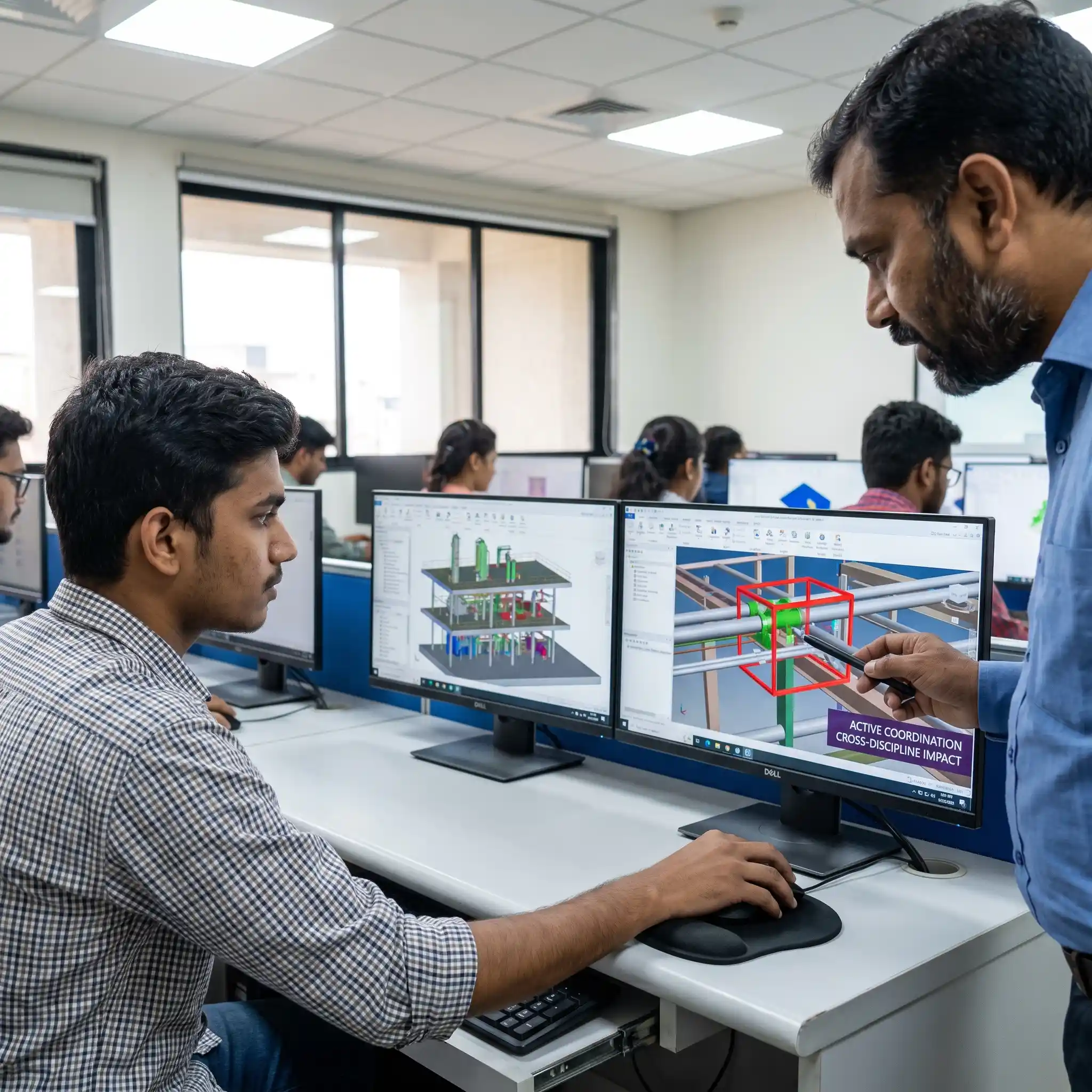
Immediate Application: Apply new modelling concepts directly into E3D to see your work inside the shared model instantly.
Cross-Discipline Impact: Understand exactly how one engineering discipline’s design decisions directly affect another’s, rather than just memorizing the software interface.
Dedicated Labs: Execute your workflows during hands-on software labs running every session on ETI’s licensed workstations in Thane and Pune.
Active Coordination: Master engineering visualization and clash-coordination exercises using sample models from other disciplines already in place.
Live Project Simulation: Navigate the exact same complex, multi-layered modeling situations you will walk into on a live multidisciplinary EPC project.
Course Outcomes
By the end of the course, you’ll be able to build and coordinate a multidisciplinary design in AVEVA E3D—placing equipment from the catalog, routing piping and cable trays, modelling structures, and resolving clashes before formal design review. That’s the real shift this course delivers: from modelling a single discipline to coordinating multiple disciplines within one intelligent plant model.
Software Covered
This course is built entirely around AVEVA E3D, part of AVEVA’s Unified Engineering platform for integrated plant design and engineering. You’ll work directly with equipment modeling, piping modeling, structural modeling, and cable tray modeling, along with the catalog and specification management tools that drive them. You’ll also get an introduction to laser scan integration for brownfield projects and the project administration basics needed to set up and manage a model correctly. All labs run on ETI’s licensed AVEVA E3D workstations in Thane and Pune.
Hands-on Projects & Portfolio
Partway through the course, you’ll build out a section of a process unit covering equipment, structure, and piping together, and run a first clash detection pass against it. Your capstone extends this into a full multidisciplinary model, adding cable tray routing and a complete engineering model review, mirroring what a design coordination engineer would actually hand off at the end of a modelling phase.
Industries Hiring Piping Designers
Secure high-demand plant design and coordination roles across major global sectors that require experts who can manage shared, multidisciplinary 3D models.
Oil & Gas Sector: Execute large-scale plant design and multidisciplinary coordination for complex upstream and downstream facilities.
Petrochemical Projects: Develop and manage intricate, intelligent 3D models for high-pressure chemical processing plants.
Power Generation Facilities: Coordinate heavy-duty piping, structural, and equipment models for massive power plant layouts.
Large Industrial Plants: Drive comprehensive plant design workflows for massive, multidisciplinary industrial manufacturing facilities.
Top-Tier EPC Contractors: Secure specialized roles by combining AVEVA E3D with CAESAR II for seamless 3D plant modelling and piping stress analysis.
Design Coordination Roles: Lead project execution by actively coordinating across engineering disciplines inside a shared 3D model, rather than designing in isolation.
Career Growth Roadmap
Entry Level (0–2 Years)
Role: E3D Modeler
Salary: ₹2.0L–₹3L p.a.
Career Progression (2–5 Years)
Role:Design Engineer
Salary: ₹4L–₹7L p.a.
Leadership Stage (5–8 Years)
Role: Design Coordinator
Salary: ₹9L–₹13L p.a.
Advanced Career Path (8+ Years)
Role: Lead Design Engineer
Salary: ₹14L–₹18L p.a.
Certification Details
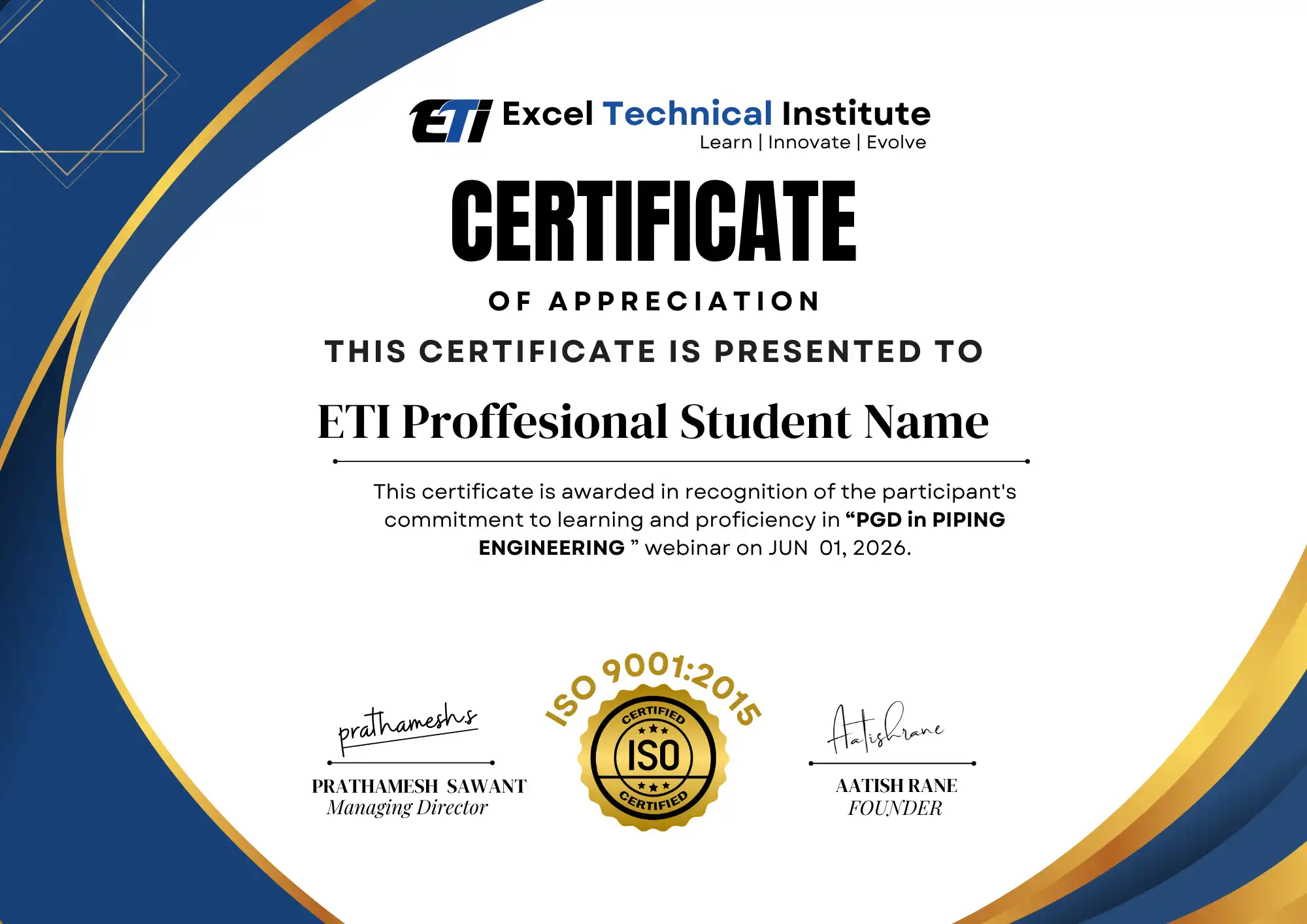
On completion, you receive the ETI course completion certificate for the AVEVA E3D Course, listing the modules covered and the specific skills developed — catalog-driven modeling, multidisciplinary coordination, clash detection, and engineering deliverables. Alongside the certificate, your capstone model and review package is what actually demonstrates your AVEVA E3D modelling and multidisciplinary coordination skills to employers working on EPC projects.
Frequently Asked Questions
Do I need prior plant design or piping experience before joining this course?
Yes, this is an advanced, specialization-level course. You should already understand piping or plant design fundamentals from a prior course or project experience. AVEVA E3D itself is taught from scratch, but the underlying plant design concepts are assumed going in.
How is AVEVA E3D different from SmartPlant 3D?
Both are rule-based, specification-driven plant design platforms used on large EPC projects. The core modelling logic is similar, but the interface, catalog structure, and multidisciplinary coordination tools differ. If the companies you’re targeting use SP3D instead, our Smart Plant 3D course covers the equivalent workflow on that platform.
Will this course cover working across multiple disciplines, or just my own?
Multidisciplinary coordination is central to this course. You’ll model equipment, structure, piping, and cable tray together in a shared model and run clash detection across all of them, since that’s how E3D projects actually work.
Do you run this course in both Thane and Pune?
Yes, both centres run the same curriculum on the same licensed AVEVA E3D software. Choose whichever centre is more convenient — there’s no difference in what’s covered at either location.
What will my portfolio include after this course?
You’ll finish with a complete multidisciplinary model from your capstone project — equipment, structure, piping, and cable tray, clash-checked and reviewed — along with the engineering deliverables produced from it, ready to show in an interview.
Ready to Start?
Seats for the next AVEVA E3D Course batch are open now at our Thane and Pune centres.
📲 WhatsApp us to check your eligibility
📄 Download the brochure for the full syllabus and fees
📞 Book a free demo class before you commit
🗓 Talk to a course advisor about your background and fit