
PG Diploma in Piping & Mechanical Engineering
➲ 4-month, intermediate-level program — designed specifically to bridge the gap between your engineering degree and an actual industry job
➲ Flexible batch timings — morning, evening, and weekend schedules built to accommodate both fresh graduates and working professionals
➲ Delivered at ETI’s Thane centre — focused, in-person training utilizing dedicated infrastructure for engineering execution
➲ Practical application over theory — stop reciting formulas and learn exactly how concepts like shell thickness calculation dictate real design decisions
➲ EPC-ready outcome — graduate with the ability to independently produce the exact drawings and datasheets that a functioning EPC office uses
Course Details
Duration
4 months
Training Mode
Classroom + Software Labs
Location
ETI Thane & Pune Centres
What You will Get?
Certification & Placement Support
Who Should Enroll
This PG Diploma in Piping and Mechanical Engineering suits BE/B.Tech graduates in Mechanical, Chemical, or Petroleum Engineering, plus diploma holders from a similar background. It also works for anyone with a couple of years in a non-design role who now wants into plant engineering. If you can read a basic drawing, you’re qualified to start.
If you want to focus on piping design only — without the mechanical equipment modules — our PG Diploma in Piping Engineering is the right starting point.
Skills You’ll Master
You’ll walk out knowing how to size a pressure vessel, specify a heat exchanger, and read a P&ID without someone explaining it to you first. You’ll build a pipe routing layout from an equipment GA drawing, prepare a proper isometric with a bill of materials, and raise a material query a vendor will actually take seriously.
Let's Learn, Innovate & Evolve with ETI
Detailed Curriculum
Introducation
The eight modules follow the order a real design job actually unfolds in. Plant understanding first, finished deliverables last.
Module 1 — Process Plant Fundamentals and Equipment Overview
- How a plant moves from FEED through detailed engineering to construction
- Plant design fundamentals every later module builds on
- What each major equipment type does and why it’s placed where it is
- Where mechanical design and piping design actually meet on a live project
Module 2 — Pressure Vessel Design
- ASME Section VIII Division 1 fundamentals
- Shell and head thickness calculations, the core engineering design calculations behind vessel sizing
- Nozzle load checks and manway sizing
- Reading a vendor datasheet properly
Module 3 — Heat Exchanger Design and Specification
- Shell-and-tube design per TEMA standards
- Thermal design basics and tube sheet/baffle calculations
- Writing a complete heat exchanger datasheet
- Where air-cooled and plate exchangers fit in
Module 4 — Rotating Equipment Fundamentals
- Centrifugal pumps per API 610
- Compressors and agitators: selection basics
- Datasheet interpretation and vendor coordination
Module 5 — Piping Components and Material Specification
- Pipes, fittings, flanges, valves, gaskets, bolting
- Building a Piping Material Specification (PMS)
- Material choices for corrosive, high-temperature, and cryogenic lines
- Flange ratings per ASME B16.5
Module 6 — P&ID Reading and Piping Layout
- Marking up P&IDs per ISA 5.1
- Developing a plant piping design layout from a plot plan and GA drawings
- Clearance, access, and drainage: the decisions that affect fabrication later
Module 7 — Isometric Drawing and Documentation
- Isometrics from a routing layout and 3D model
- Weld mapping and spool numbering
- Generating a bill of materials
- Checking your own drawing against a QC list
Module 8 — Codes, Standards, and Software Lab
- ASME B31.3, B31.1, Section VIII, TEMA, and API 610 applied to real problems
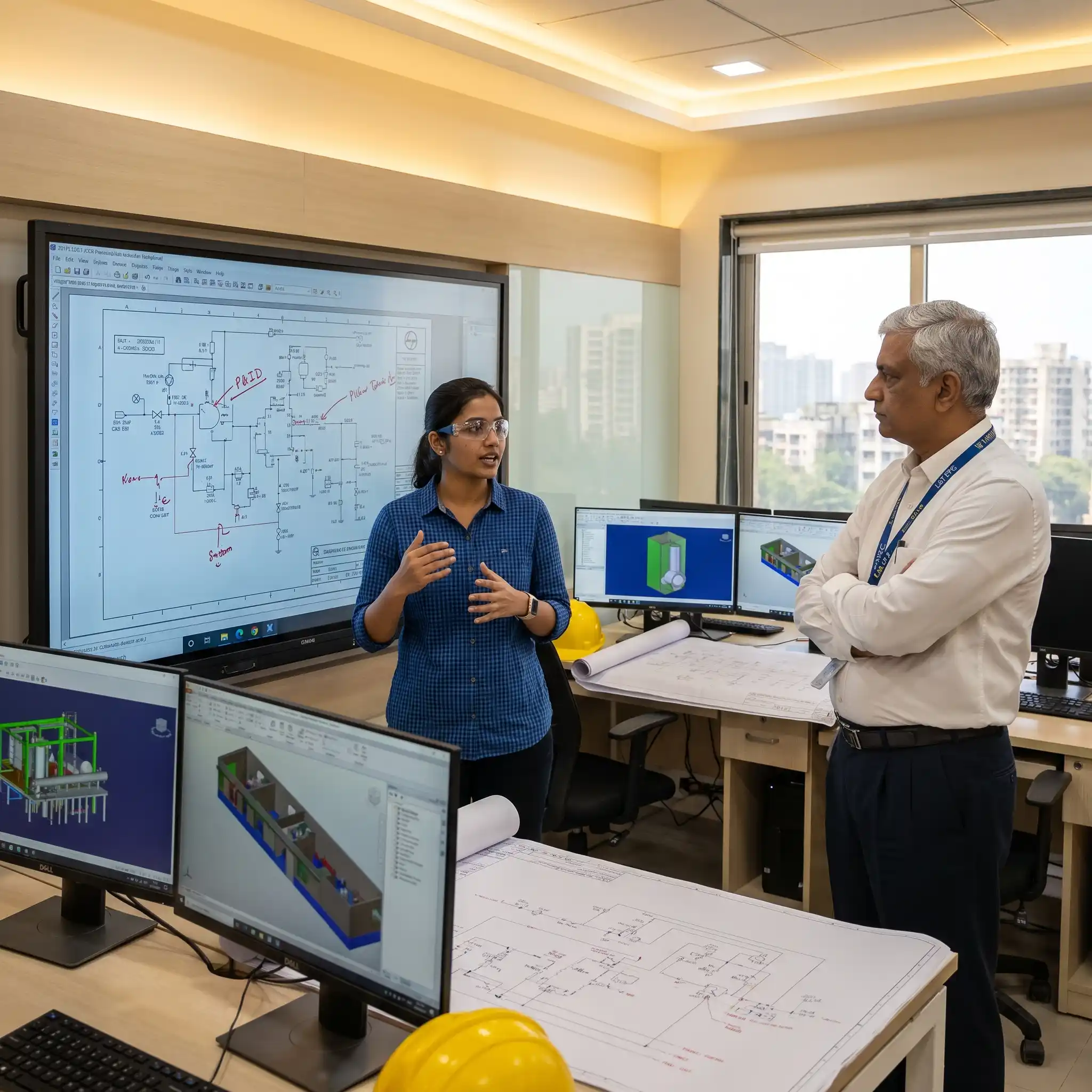
- AutoCAD and AutoCAD Plant 3D lab sessions running alongside the theory
- Capstone project
Learning Methodology
Reasoning before execution — each module explains the engineering rationale first, ensuring you understand exactly what a calculation (like nozzle loads) protects against before executing it.
Labs run alongside theory, not after it — software practice runs concurrently with theory on ETI’s own physical machines in Thane, not sequentially after the module ends.
Real project drawings, not textbook exercises — course materials consist of real, anonymized industry project drawings rather than simplified, theoretical textbook exercises.
Mark up and defend, not just observe — you must identify drawing errors and verbally defend your corrections out loud, strictly mirroring the rigors of an actual design review.
Faculty with live project backgrounds — instructors teach from decisions they have actually made on EPC projects, not from a fixed set of course notes.
Course Outcomes
Graduates leave with two things most fresh engineers don’t have: a working knowledge of both mechanical equipment design and piping design engineering, and a portfolio of real project files to show for it. That combination is what gets you shortlisted for a junior design engineer role over someone who only studied one side of plant design.
Software Covered
You’ll train on AutoCAD for 2D mechanical drafting and general arrangement drawings, and E3D for pipe routing, 3D modelling with SolidWorks, and isometric extraction. Everything runs on licensed machines at the Thane centre. If you’ve never opened either programme before, that’s fine. The labs start from zero and build up alongside the theory modules.
Hands-on Projects & Portfolio
Midway through, you’ll work a distillation unit case study: process data, a preliminary P&ID, GA drawings, and you’ll produce a heat exchanger datasheet plus three isometrics. Your capstone builds out a full process skid. It includes vessel and exchanger datasheets, a piping GA, four isometrics, and a line list, all checked against a real QC checklist.
Industries Hiring Piping & Mechanical Engineers
Employers in industrial plant engineering across Mumbai, Thane, Navi Mumbai, and Pune specifically look for candidates who can handle both equipment and piping. Graduates of this diploma work across the following sectors:
Oil and gas — upstream wellhead facilities, midstream pipelines, and downstream refineries
Petrochemical — specialty chemical plants and process facilities
Pharmaceutical — drug manufacturing and API production units
Power generation — thermal, combined cycle, and captive power plants
Water treatment — industrial wastewater and municipal treatment infrastructure projects
EPC Consultancies & Fertilisers — engineering firms executing agrochemical and plant layouts
Career Growth Roadmap
Entry Level (0–2 Years)
Role: Junior Design Engineer
Salary: ₹3.0L–₹5.5L p.a.
Career Progression (2–5 Years)
Role: Piping Design Engineer
Salary: ₹5.5L–₹9L p.a.
Leadership Stage (5–8 Years)
Role: Senior Piping Engineer
Salary: ₹9L–₹14L p.a.
Advanced Career Path (8+ Years)
Role: Lead Piping Engineer
Salary: ₹14L–₹20L p.a.
Certification Details
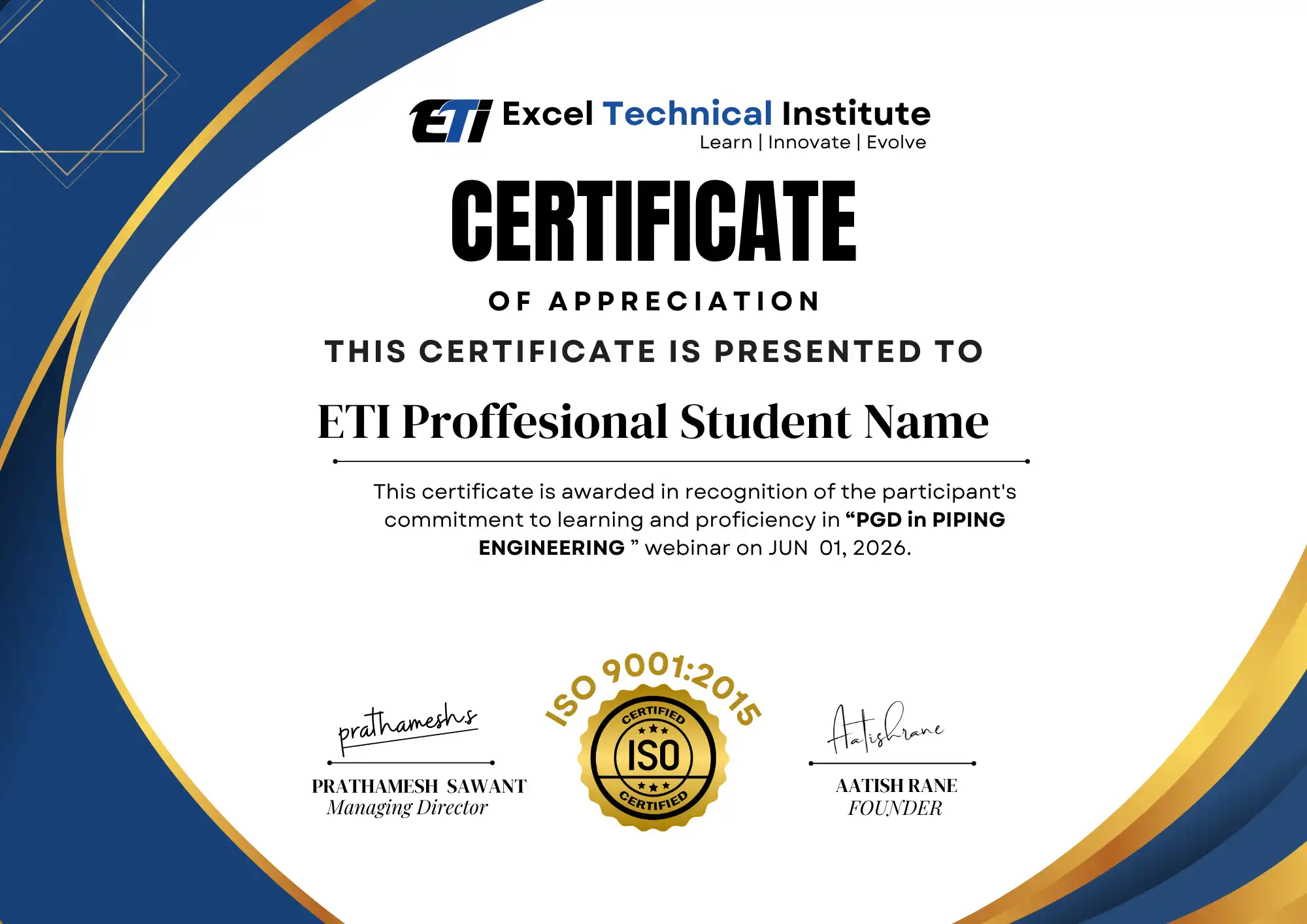
Your ETI certificate lists the modules completed, the codes studied (Section VIII, B31.3, TEMA, API 610), and the software you trained on. It’s useful in an interview, but it’s not the thing that gets you hired on its own. Your project files do that job. The certificate just confirms you sat through the training that produced them.
Frequently Asked Questions
Is this suitable for a fresh BE Mechanical graduate with zero work experience?
Yes. That’s who this programme is built for. No prior experience or software knowledge is assumed anywhere in the syllabus.
How is this different from a standalone piping course?
A standalone piping course covers routing and isometrics only. This diploma adds mechanical equipment design — vessels, exchangers, rotating equipment — plus the codes attached to them.
Can working professionals join?
Yes, weekend and evening batches at the Thane centre are built specifically for people holding a job while they train.
Do I need to buy or install any software myself?
No. AutoCAD and AutoCAD Plant 3D are available on ETI’s own licensed workstations for every lab session.
Does ETI help with placements after the course?
Yes, through direct connections with EPC contractors and engineering consultancies across Mumbai, Thane, Navi Mumbai, and Pune, along with resume and interview support.`
Ready to Start?
Seats for the next batch of this Post Graduate Diploma in Piping and Mechanical Engineering are filling up at our Thane centre.
📲 WhatsApp us to check your eligibility
📄 Download the brochure for the full syllabus and fee structure
📞 Book a free demo class before you commit
🗓 Request a counselling call to talk through your background and fit