
CAESAR II Course
➲ Validate piping layouts instead of guessing by accurately modelling complex piping systems in CAESAR II.
➲ Evaluate sustained, thermal, and occasional loads to guarantee your layout will actually survive thermal growth over twenty years of operation.
➲ Understand what stress results actually mean for a piping system, rather than just checking if a line passes or fails.
➲ Elevate your existing piping design background by adding advanced, specialization-level pipe stress analysis to your core capabilities.
➲ Learn to build a model, apply the right loads, and interpret the data exactly the way a professional stress engineer reads them.
Course Details
Duration
1 month
Training Mode
Classroom + Software Labs
Location
ETI Thane & Pune
What You will Get?
Certification
Who Should Enroll
This course suits engineers who’ve already completed a piping design or piping engineering course, or who have some hands-on piping project experience, and now want to specialise in stress analysis specifically. It also works well for senior draughtsmen or piping designers looking to move into a more technical, analysis-focused role. You don’t need prior CAESAR II experience. You do need to already be comfortable with piping layouts, P&IDs, and basic piping components, since the course builds stress analysis on top of that foundation rather than teaching it from zero.
If you need to build that piping foundation first, our Master Diploma in Piping Engineering covers stress fundamentals alongside advanced piping design — a strong base before specialising in full stress analysis.
Skills You’ll Master
You’ll learn to build an accurate piping model in CAESAR II and run sustained stress analysis, thermal stress analysis, and occasional load analysis on it. You’ll get comfortable applying stress intensification factors correctly at fittings and branches, understand what expansion stress analysis is actually protecting against, and learn to read nozzle load results well enough to know whether a connected vessel or pump nozzle can actually take what your piping system is putting on it.
Let's Learn, Innovate & Evolve with ETI
Detailed Curriculum
Introducation
The course moves in the order a real stress analysis job actually unfolds — model first, loads next, results last.
Module 1 — Piping Stress Analysis Fundamentals
- Why piping systems need stress analysis in the first place
- Introduction to the CAESAR II interface and modelling environment
- Basic pipe stress analysis terminology and concepts
Module 2 — Building the Piping Model
- Modelling pipe runs, bends, and fittings accurately
- Applying stress intensification factors (SIF) at fittings and branches
- Setting up supports and restraints correctly
Module 3 — Sustained and Thermal Stress Analysis
- Running sustained stress analysis for weight and pressure loads
- Thermal stress analysis and how a system responds to temperature change
- Understanding piping flexibility analysis and why routing affects results
Module 4 — Occasional Loads and Expansion Stress
- Occasional load analysis for wind, seismic, and other transient events
- Expansion stress analysis across full operating cycles
- Comparing load cases to see which one actually governs
Module 5 — Nozzle Loads and Equipment Interaction
- Nozzle load analysis at pumps, vessels, and other connected equipment
- Interpreting allowable loads against actual results
- What to do when a nozzle load result fails
Module 6 — Results Interpretation and Reporting
- Reading a full CAESAR II output report properly
- Identifying real problems versus acceptable results
- Capstone project: a complete piping stress analysis, from model build to final report, for a real-scale piping system
Learning Methodology
Conceptual Foundation: Understand exactly what a thermal load is actually doing to a pipe before you start staring at a CAESAR II results table.
Strategic Modelling: Master the core engineering reasoning behind every stress concept before you are asked to physically model it.
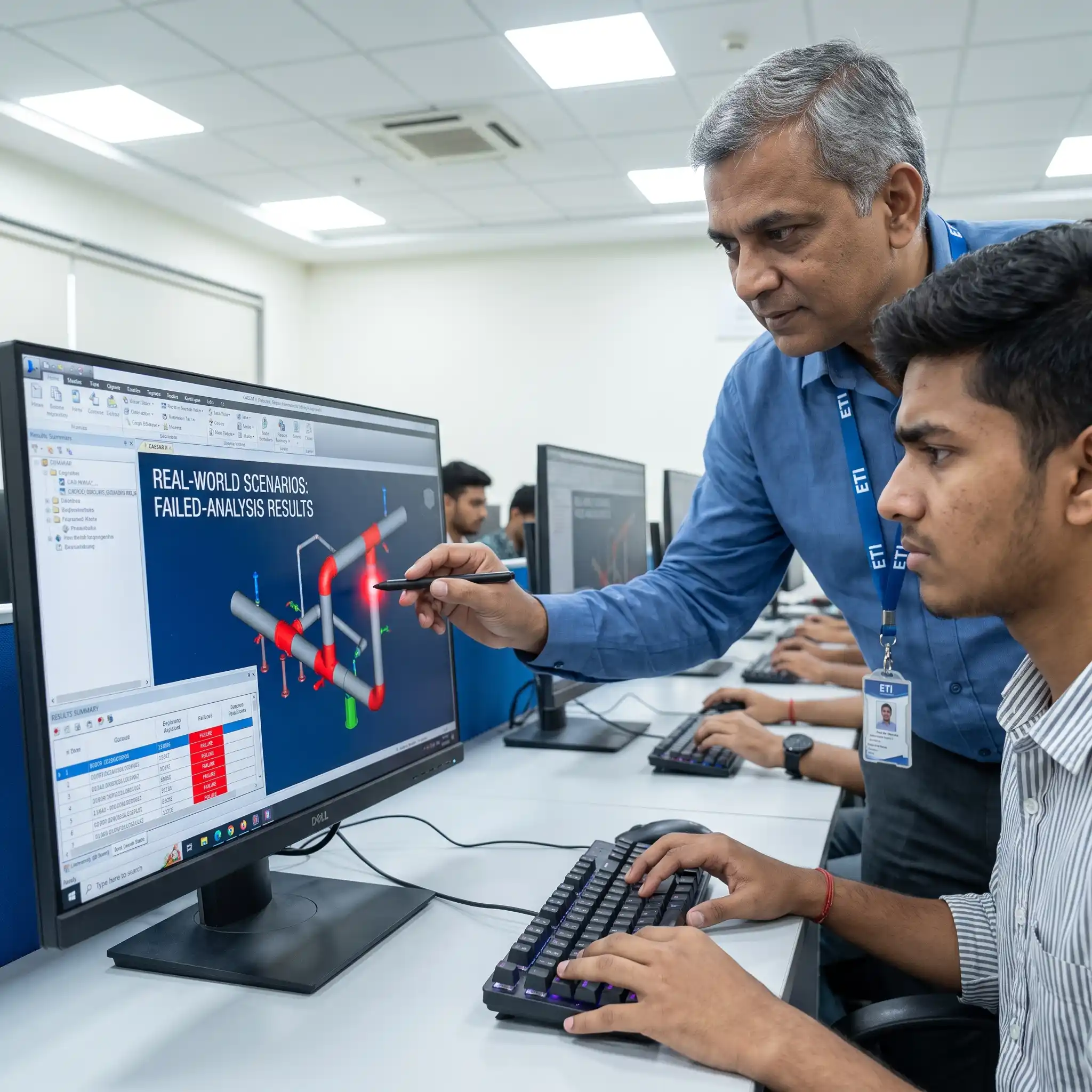
Dedicated Labs: Execute your analysis workflows during hands-on software labs running every session on ETI’s own CAESAR II workstations in Thane and Pune.
Real-World Scenarios: Work through the exact kind of real failed-analysis results that a junior stress engineer actually runs into on the job.
Model Troubleshooting: Learn how to strategically fix a failing model rather than just blindly re-running the software and hoping for a different answer.
Course Outcomes
By the end, you can take a piping layout, model it properly in CAESAR II, and run a complete piping system analysis covering sustained, thermal, and occasional loads. More importantly, you’ll understand why a result fails, not just that it did — which is the difference between someone who runs the software and someone a project actually trusts to sign off on a stress report.
Software Covered
This course is built entirely around CAESAR II, the industry-standard pipe stress analysis and piping flexibility analysis software used by EPC companies worldwide. You’ll work through model building, load case setup, and results interpretation directly in the software, using the same workflow a working stress engineer follows on a real project. All labs run on ETI’s licensed CAESAR II workstations in Thane and Pune, so there’s nothing to install or license yourself.
Hands-on Projects & Portfolio
Partway through the course, you’ll take a moderately complex piping layout and build a complete stress model from it, running sustained and thermal analysis and interpreting the results. Your capstone goes further: a full piping system analysis covering all major load cases, nozzle load checks, and a finished report, the same deliverable a stress engineer would actually submit for project review.
Industries Hiring Pipe Stress Engineers
Caesar II is used wherever piping systems carry pressure and temperature loads. Graduates with pipe stress analysis skills find consistent demand across:
Oil and Gas: Validate thermal loads on pipe runs for upstream facilities, gas treatment plants, and refineries where stress sign-off is mandatory.
Petrochemical and Chemical Plants: Analyse high-temperature, high-pressure piping systems for petrochemical and specialty chemical plants where ASME code compliance is non-negotiable.
Power Generation: Perform flexibility analysis on steam piping for thermal and combined cycle power plants where temperature loads govern every routing decision.
Pharmaceutical Manufacturing: Validate piping layouts in pharmaceutical plants where GMP regulations and ASME B31.3 code compliance are both mandatory for approval.
Fertiliser and Agrochemical Plants: Analyse elevated-temperature process piping across large plot areas where thermal expansion and pipe support design are both critical.
EPC Contractors and Consultancies: Work directly with firms designing plants across every sector — the most common employers for Caesar II-trained engineers in India.
Career Growth Roadmap
Entry Level (0–2 Years)
Role: Junior Stress Engineer
Salary: ₹2.0L–₹3L p.a.
Career Progression (2–5 Years)
Role: Stress Engineer
Salary: ₹3L–₹5L p.a.
Leadership Stage (5–8 Years)
Role: Senior Stress Engineer
Salary: ₹7L–₹11L p.a.
Advanced Career Path (8+ Years)
Role: Lead Stress Engineer
Salary: ₹12L–₹19L p.a.
Certification Details
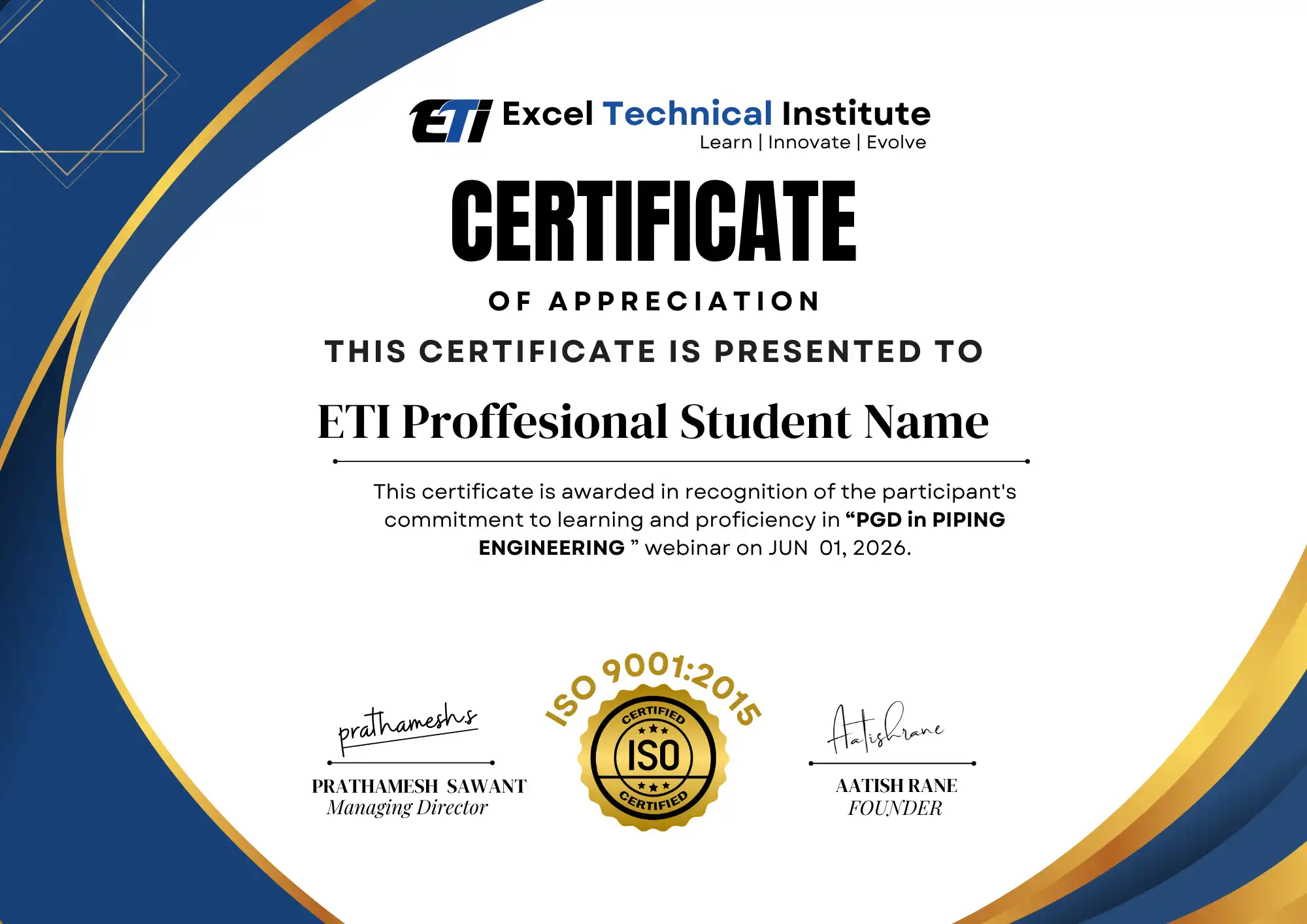
On completion, you receive the ETI course completion certificate for the CAESAR II Course, listing the modules covered and the specific stress analysis skills developed — model building, load case analysis, and results interpretation. Alongside the certificate, your capstone stress report is what actually demonstrates your analysis ability to an employer, since that’s the kind of document you’d be producing on the job.
Frequently Asked Questions
Do I need prior piping design experience before joining this course?
Yes, this is a specialization-level course. You should already be comfortable with piping layouts, P&IDs, and basic components. CAESAR II is taught from scratch, but piping fundamentals are assumed. If you need that foundation first, our PG Diploma in Piping Engineering is the right starting point.
Will I actually understand the theory, or is this just software training?
Both. Each module explains the engineering reasoning behind a load case before you model it, so you understand why sustained, thermal, and occasional loads behave differently, not just which buttons produce which report.
Is this course only useful for oil and gas projects?
No. Pipe stress analysis is needed anywhere piping systems carry pressure and temperature loads — petrochemical, power, and general process industries all need it. The fundamentals taught here apply across sectors, not just one.
Do you run this course in both Thane and Pune?
Yes, both centres run the same curriculum on the same licensed CAESAR II software. Choose whichever centre is more convenient — there’s no difference in what’s covered at either location.
What will my portfolio include after this course?
You’ll finish with a complete stress analysis report from your capstone project, covering model setup, load case analysis, results interpretation, and nozzle load checks, structured the same way a real project deliverable would be, ready to show in an interview.
Ready to Start?
Seats for the next CAESAR II Course batch are open now at our Thane and Pune centres.
📲 WhatsApp us to check your eligibility
📄 Download the brochure for the full syllabus and fees
📞 Book a free demo class before you commit
🗓 Talk to a course advisor about your background and fit