
Piping Draughtsman Course
➲ Learn to turn a P&ID into finished piping drawings.
➲ Master the creation of general arrangement layouts, isometrics, and support drawings.
➲ Deliver final outputs drafted the way an EPC drafting department actually expects them.
➲ Execute your designs using the CAD tools drafting teams use every day.
Course Details
Duration
2.5 months
Training Mode
Classroom + Software Labs
Location
ETI Thane & Pune
What You will Get?
Certification
Who Should Enroll
This course suits BE/B.Tech or diploma graduates in Mechanical, Chemical, or Petroleum Engineering, and also works well for ITI or polytechnic candidates with a drafting background. Some basic familiarity with AutoCAD is helpful but not required. If you can read a simple engineering drawing and want to specialise in piping, this course is built for you.
Not sure if drafting is the right entry point for you? Our Piping Engineering course covers the broader design side and may be a better fit depending on your background.
Skills You’ll Master
You’ll learn to produce piping general arrangement drawings from a plot plan and equipment layout, and to draft accurate piping isometric drawings with a complete bill of materials. You’ll get hands-on with piping components — valves, fittings, flanges, supports — and how they’re represented correctly on a drawing. You’ll also learn to apply drafting standards consistently, so your drawings hold up under a formal design review, not just a quick glance.
Let's Learn, Innovate & Evolve with ETI
Detailed Curriculum
Introducation
This piping draughtsman course is a foundation-level programme built for anyone who wants to become a working piping drafter, not just someone who’s used AutoCAD before. Over three months, you’ll learn how piping drawings actually get produced on a project: starting from a P&ID and equipment layout, and ending with general arrangement drawings, isometrics, and support drawings ready to issue. It’s built for fresh engineering or diploma graduates, as well as anyone with basic CAD exposure who wants structured, drafting-specific training. By the end, you’ll be able to produce a complete set of piping drawings to the standards a drafting checker actually looks for, not just drawings that look correct.
Module 1 — Piping Design Fundamentals and Drafting Basics
- Introduction to industrial piping systems and how a plant is laid out
- Piping components and their standard drafting symbols
- Engineering drawing standards used across EPC projects
Module 2 — Equipment Layout and Plant Layout Drawings
- Reading equipment layout drawings and plot plans
- Process plant layout conventions and spacing rules
- Positioning equipment correctly before piping is drafted around it
Module 3 — Piping General Arrangement Drawings
- Developing a piping general arrangement drawing from a P&ID and layout
- Dimensioning, annotation, and drawing scale conventions
- Common GA drawing errors and how reviewers catch them
Module 4 — Piping Material Specification and Bill of Materials
- Reading a Piping Material Specification (PMS) as a drafter
- Producing an accurate piping bill of materials from a drawing
- Matching components on the drawing to the correct specification
Module 5 — Piping Isometric Drawings
- Drafting isometric drawings from a GA and 3D reference
- Weld numbering, spool breaks, and dimensional accuracy
- Producing a drawing set ready for fabrication
Module 6 — Pipe Support Drawings and Documentation
- Drafting pipe support drawings to standard formats
- Building complete piping design documentation for issue
- Capstone project: a full piping drawing package for a small process unit
Learning Methodology
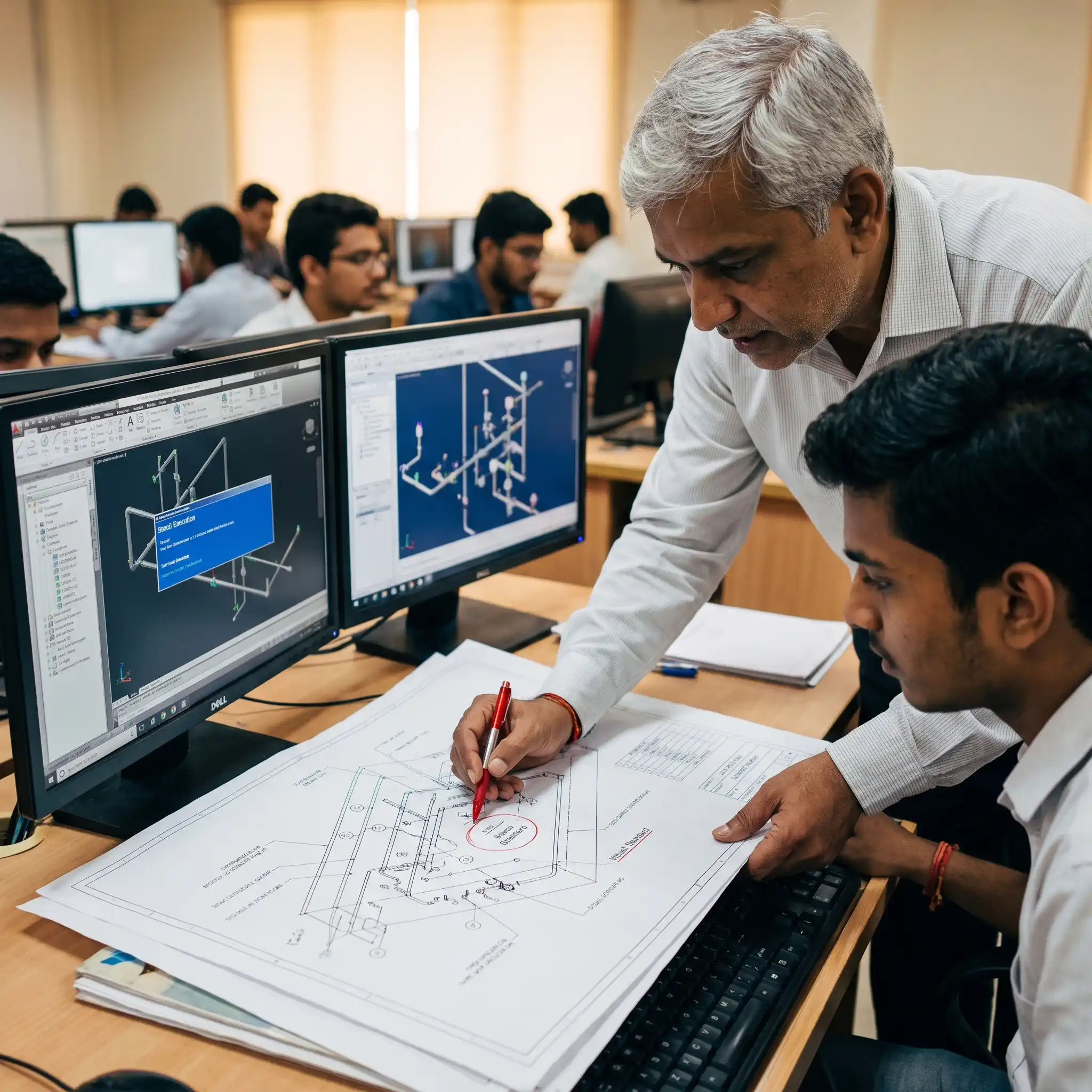
Reference Drawings: Start every module by analyzing a real drawing example before you are asked to produce one yourself.
Visual Standard: See exactly what a correct, site-ready GA drawing or isometric actually looks like before drafting your own.
Practical Labs: Execute your designs during software labs running alongside every module on ETI’s machines in Thane and Pune.
Live Markups: Get your completed drawings checked, corrected, and actively marked up directly in class.
Industry Review: Experience the exact same review process a senior drafter uses for a junior’s work on an actual project.
Course Outcomes
Graduates are able to take a set of process inputs and produce a professional piping drawing package independently — GA drawings, isometrics, and support drawings, all dimensioned and annotated correctly. That’s the specific, drafting-focused skill set that separates someone who knows AutoCAD from someone a drafting department can actually put on a live project from week one.
Software Covered
The course is built around AutoCAD for piping, covering 2D drafting conventions, layering standards, and drawing templates used across the industry. You’ll also get an introduction to Plant 3D for extracting isometrics from a modelled layout, so you understand both the traditional 2D workflow and how modern piping CAD drafting increasingly works. All labs run on ETI’s licensed workstations in Thane and Pune— nothing to install at home.
Hands-on Projects & Portfolio
Midway through, you’ll take a P&ID and equipment layout for a small process section and produce a complete GA drawing plus two isometrics from it. Your capstone extends this into a full drawing package — GA, isometrics, support drawings, and a bill of materials — checked against the same standards a drafting supervisor would apply on a live project.
Industries Hiring Piping Designers
Top-tier EPC consultancies and global heavy industries actively hire our graduates because they demand drafters who understand real-world layout logic, not just basic CAD operators.
Oil & Gas Sector: Draft precise piping layouts and isometrics for massive upstream and downstream refinery networks.
Petrochemical & Chemical Plants: Develop complex general arrangement drawings for critical, high-pressure chemical processing units.
Pharmaceutical Manufacturing: Create the high-precision, hygienic piping routing required for strict industrial manufacturing standards.
Power Generation Facilities: Execute heavy-duty steam and utility piping drawings for large-scale power plants.
Water Treatment Projects: Map out industrial-scale fluid distribution networks and pump station support drawings.
Top-Tier EPC Contractors: Secure roles in dedicated drafting departments that demand deep layout logic and component knowledge.
Career Growth Roadmap
Entry Level (0–2 Years)
Role: Junior Piping Draughtsman
Salary: ₹2.0L–₹3L p.a.
Career Progression (2–5 Years)
Role: Piping Draughtsman
Salary: ₹3L–₹5L p.a.
Leadership Stage (5–8 Years)
Role: Senior Piping Draughtsman
Salary: ₹5L–₹9L p.a.
Advanced Career Path (8+ Years)
Role: Piping Designer
Salary: ₹9L–₹13L p.a.
Certification Details
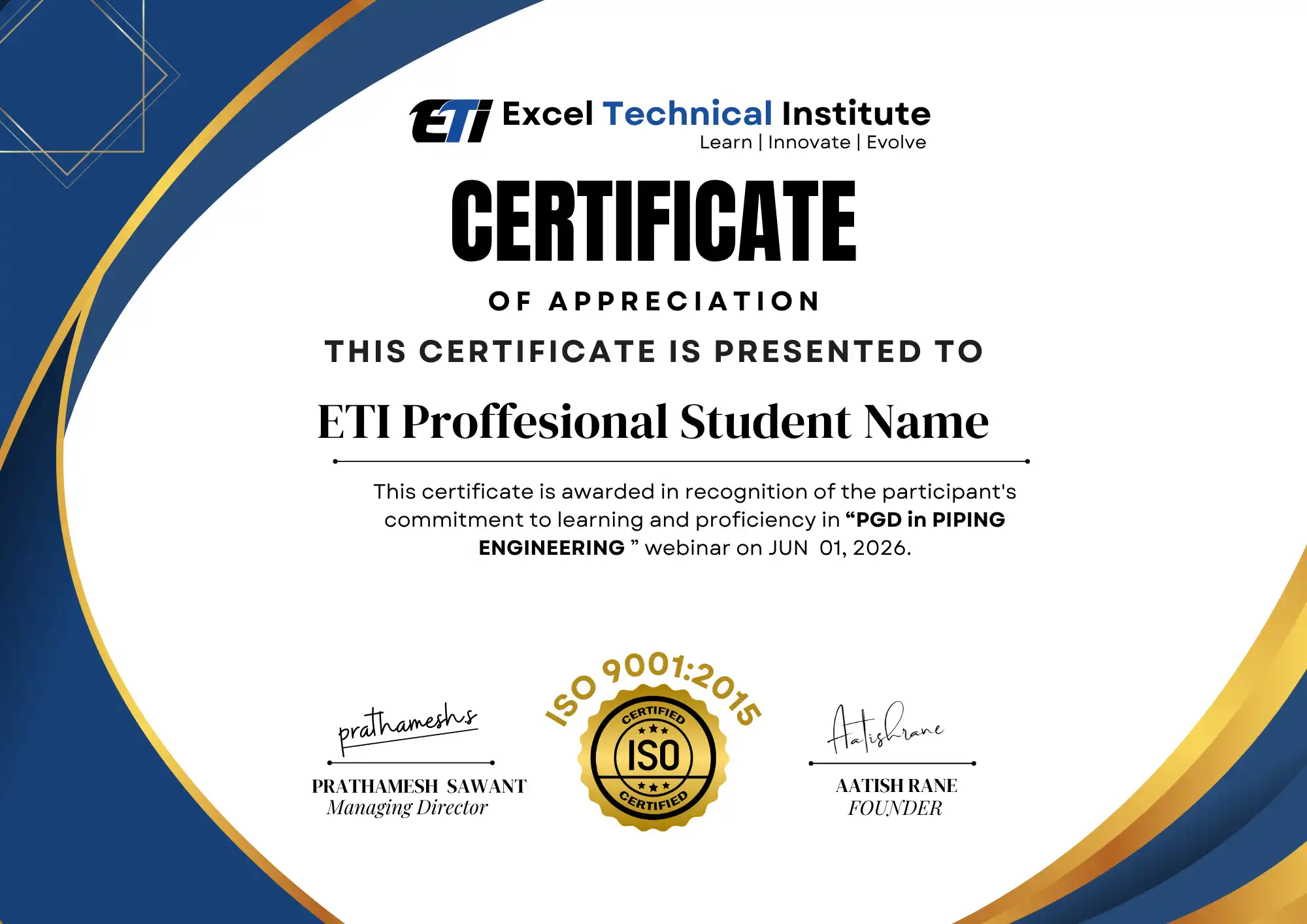
On completion, you receive the ETI certificate for the Piping Draughtsman Course, listing the modules completed, drafting standards applied, and the software trained on. The certificate confirms the training you’ve completed. Your drawing package from the capstone project is what actually demonstrates your drafting ability to an employer.
Frequently Asked Questions
Do I need prior AutoCAD experience to join this course?
No, prior AutoCAD experience isn’t required. The course starts from basic drafting principles and builds up to full piping GA drawings and isometrics. Some familiarity with any CAD software helps you move faster, but it isn’t a prerequisite for enrolling.
How is this different from a general AutoCAD course?
A general AutoCAD course teaches the software itself. This piping drafting course teaches piping-specific conventions — components, layout rules, isometric standards — so drawings you produce actually meet industry drafting expectations, not just general CAD correctness.
Is this course suitable for diploma or ITI candidates?
Yes, this course is well suited to diploma and ITI graduates with a drafting or mechanical background. It’s built to develop practical drafting skills rather than assume an engineering degree, so the entry bar is lower than most piping design courses.
Will I learn 3D modelling in this course?
You’ll get an introduction to Plant 3D for isometric extraction, but the primary focus is 2D piping CAD drafting. Learners wanting deeper 3D modelling and design responsibility typically continue with our PG Diploma in Piping Engineering.
What kind of role can I expect to apply for after this course?
You’ll be equipped to apply for Junior Piping Draughtsman roles, producing GA drawings, isometrics, and support drawings under supervision. Your capstone drawing package becomes the portfolio you show employers directly during interviews, alongside the skills built through the course.
Ready to Start?
Seats for the next batch of the Piping Draughtsman Course are open now at our Thane and Pune centre.
📲 WhatsApp us to check your eligibility
📄 Download the brochure for the full syllabus and fees
📞 Book a free demo class before you commit
🗓 Talk to a course advisor about your background and fit