
Piping Engineering Course
➲ Learn to read a P&ID, build a precise piping layout, and turn it into project-ready documentation.
➲ Transition from academic theory into practical application with this hands-on, foundation-level piping design course.
➲ Master exactly how a real process plant piping system is actually designed from the ground up.
➲ Progress directly from reading initial P&IDs through to producing a highly accurate isometric fabricator.
➲ Produce the exact core documents a junior piping design engineer is expected to deliver on day one of a project.
Course Details
Duration
2 months
Training Mode
Classroom + Software Labs
Location
ETI Thane & Pune
What You will Get?
Certification
Who Should Enroll
This course suits BE/B.Tech graduates in Mechanical, Chemical, or Petroleum Engineering, along with diploma holders from a similar background. It also works for professionals with some plant exposure who now want structured piping design training. No prior AutoCAD or piping knowledge is assumed. If you can read a basic engineering drawing, you’re ready to start.
If you have no CAD background at all, our AutoCAD course is a one-month foundation you can complete before or alongside this programme.
Skills You’ll Master
You’ll learn to interpret a P&ID accurately, develop a piping layout from an equipment GA drawing, and prepare isometric drawings with a complete bill of materials. You’ll get comfortable with piping components — valves, fittings, flanges, gaskets — and how they’re selected for different services. You’ll also learn to raise a material query, read a vendor response, and produce documentation another engineer can pick up without asking you to explain it first.
Let's Learn, Innovate & Evolve with ETI
Detailed Curriculum
Introducation
The course is structured around the order a piping design job actually unfolds in — plant context first, deliverables last.
Module 1 — Process Plant Piping Fundamentals
- How process plant piping fits into the overall plant design lifecycle
- Piping components and their function: valves, fittings, flanges, gaskets, bolting
- Introduction to piping design documentation used on real projects
Module 2 — P&ID Interpretation and Piping Layout
- P&ID interpretation using ISA symbology
- Developing a piping layout from a plot plan and equipment GA drawing
- Clearance, access, and drainage considerations that shape routing
Module 3 — Piping Material Engineering
- Piping Material Specification (PMS) reading and basic development
- Material selection for corrosive, high-temperature, and cryogenic services
- Flange ratings and component selection logic
Module 4 — Pipe Routing and Isometric Drawings
- Pipe routing principles for straightforward plant layouts
- Preparing piping isometric drawings from a routing layout
- Weld mapping, spool numbering, and Material Take-Off (MTO) basics
Module 5 — Pipe Support Design Fundamentals
- Common support types and where each applies
- Basic engineering calculations behind support placement
- Documenting supports for fabrication
Module 6 — Piping Design Workflow and Software Lab
- How piping design moves through a project — from concept to issue
- AutoCAD and AutoCAD Plant 3D lab sessions applied to a plant scenario
- Capstone project: a complete piping design package for a small process unit

Learning Methodology
Engineering Reasoning: Understand the core engineering reasoning behind a design decision before you are asked to apply it.
Logical Routing: Ensure every complex piping routing choice makes complete technical sense before you begin drawing it.
Dedicated Labs: Execute your workflows during practical software labs running alongside every module on ETI’s own machines.
Active Markups: Analyze real, anonymised project drawings in class to actively mark up issues and explicitly explain your corrections.
Interface Skills: Build the critical process engineering interface skills that come up constantly during actual design reviews.
Course Outcomes
Graduates leave with a working understanding of the full piping design workflow, from P&ID interpretation to issued-for-construction isometrics. More importantly, you’ll understand why a routing decision is made a certain way, not just how to draw it. That distinction is what separates someone who can operate software from someone who can actually design piping for an industrial piping design project.
Software Covered
The course trains you on AutoCAD for 2D piping drawings and documentation, with an introduction to AutoCAD Plant 3D for pipe routing and isometric extraction in a modelled environment. Labs run on ETI’s own licensed workstations in Thane, so there’s nothing to install or purchase. If you’ve never opened either tool before, the labs are built to start from zero.
Hands-on Projects & Portfolio
Midway through, you’ll work a case study covering a section of process plant piping: a P&ID, a plot plan, and equipment GA drawings, from which you’ll produce a routing layout and two isometrics. Your capstone builds this into a complete package — layout, isometrics, MTO, and support drawings — reviewed against a QC checklist used on real projects.
Industries Hiring Piping Designers
Secure high-demand piping design and field engineering roles across major global industries that value real-world layout logic and practical project execution.
Oil & Gas Sector: Step into critical piping design roles managing extensive upstream, midstream, and downstream facility layouts.
Petrochemical & Specialty Chemical: Develop precise piping engineering documentation for high-complexity chemical processing units.
Pharmaceutical Plants: Design specialized, high-purity piping systems that comply with strict hygienic manufacturing standards.
Power Generation & Water Infrastructure: Map out heavy-duty utility routing and fluid distribution networks for massive industrial infrastructure.
EPC Contractors & Consultancies: Deliver project-ready piping engineering designs and core deliverables for global engineering consultants.
Plant Construction & Commissioning: Transition your site-level piping knowledge directly into high-value field execution, inspection, and commissioning support roles.
Career Growth Roadmap
Entry Level (0–2 Years)
Role: Junior Engineer
Salary: ₹2.0L–₹3L p.a.
Career Progression (2–5 Years)
Role: Design Engineer
Salary: ₹3L–₹5L p.a.
Leadership Stage (5–8 Years)
Role: Senior Engineer
Salary: ₹5L–₹9L p.a.
Advanced Career Path (8+ Years)
Role: Lead Engineer
Salary: ₹9L–₹13L p.a.
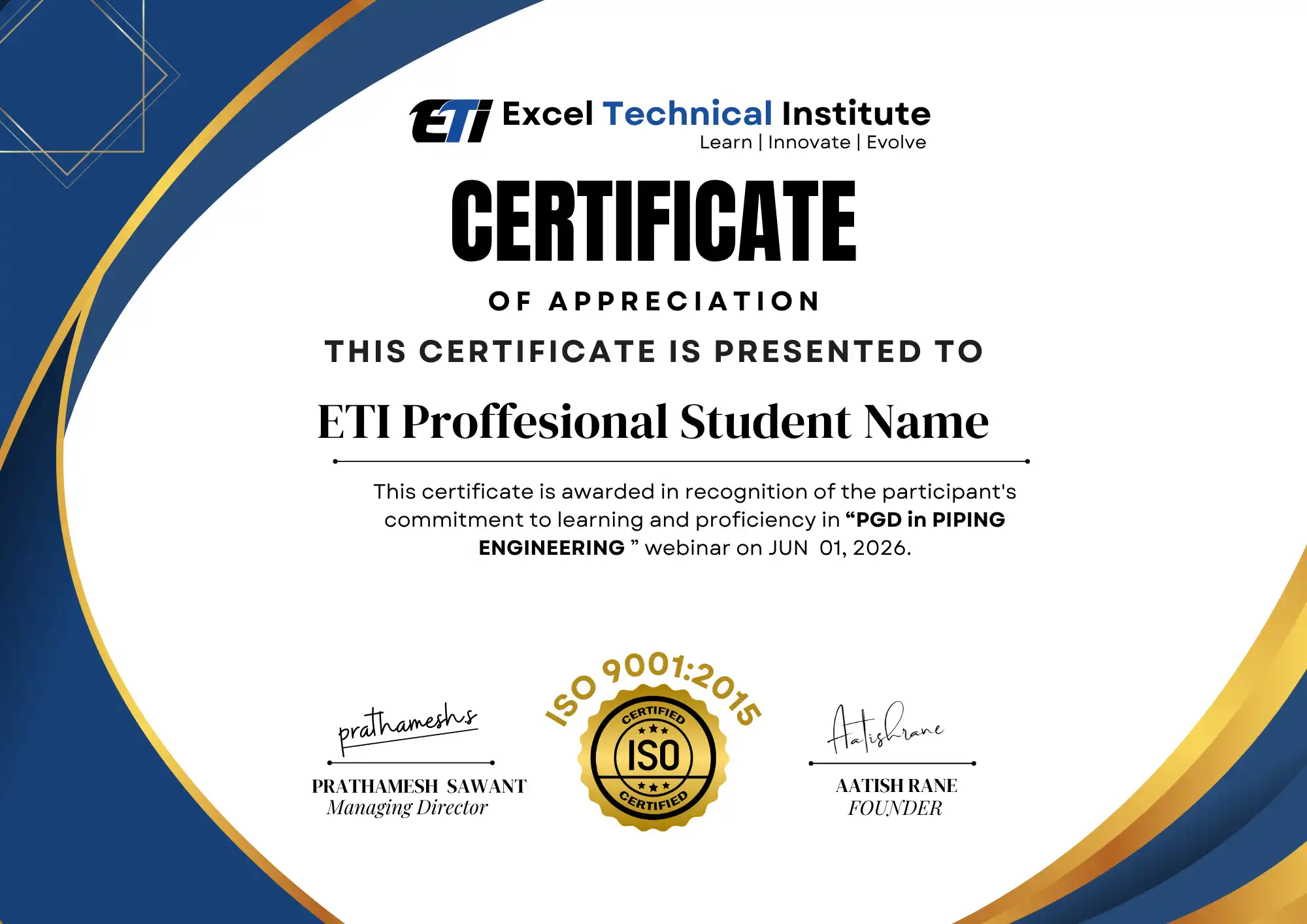
Certification Details
On completion, you receive the ETI certificate for the Piping Engineering Course, listing the modules completed, ASME B31.3 application, and the software trained on. The certificate confirms the training. Your project portfolio, built through the case study and capstone, is what actually demonstrates the skill in an interview.
Engineers who complete this course and want to go further into full piping design workflow — including isometrics, codes, and software labs — typically progress to the PG Diploma in Piping Engineering.
Frequently Asked Questions
Is this course suitable for someone with zero piping background?
Yes, this is a foundation-level piping design course built for exactly that. No prior AutoCAD knowledge or piping exposure is assumed anywhere in the syllabus, and every module starts from first principles before building up.
What's the difference between this and the Master Diploma in Piping Engineering?
This course covers foundational piping design: layout, isometrics, and material basics. The Master Diploma adds 3D modelling, stress fundamentals, clash detection, and project engineering workflow for those ready to move into detailed engineering roles.
Do I need to buy any software before joining?
No. AutoCAD and AutoCAD Plant 3D are available on ETI’s licensed workstations for every lab session, so there’s nothing to install or purchase on your own system.
Can working professionals attend this course?
Yes, evening and weekend batches are available at the Thane centre specifically for people who want to train while continuing to work.
Does this course help with placement afterward?
Yes, through ETI’s placement cell, which maintains relationships with EPC contractors and engineering consultancies, along with resume support and interview preparation for piping design roles.
Ready to Start?
Seats for the next batch of the Piping Engineering Course are open now at our Thane centre.
📲 WhatsApp us to check your eligibility
📄 Download the brochure for the full syllabus and fees
📞 Book a free demo class before you commit
🗓 Talk to a course advisor about your background and fit