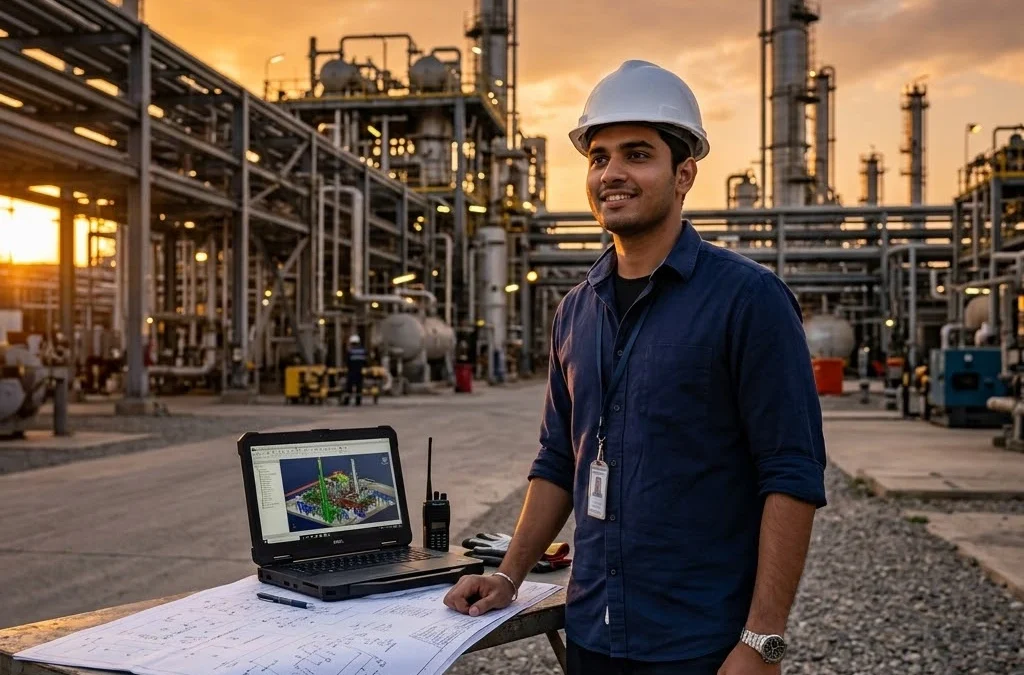
India’s engineering, procurement, and construction (EPC) sector just recorded a 51% surge in hiring demand — and it is not slowing down. Refineries are expanding, petrochemical projects are being greenlit, and LNG terminals are under construction. The jobs exist. The real question is whether your resume is ready for them.
Here is the uncomfortable truth: most engineering graduates are not on EPC shortlists — not because they lack intelligence, but because their training never went deep enough into plant design. EPC companies do not hire for general mechanical knowledge. They hire for specific, demonstrable skills — and a focused piping engineering course is one of the fastest ways to build exactly that.
What EPC Companies Actually Look For
Walk through any recent job posting from L&T, Worley, Petrofac, or Jacobs and a pattern emerges immediately. These companies are not asking for a 7.5 CGPA or an MBA. They are asking for:
- Working knowledge of ASME B31.3 (Process Piping) and ASME B31.1 (Power Piping)
- Hands-on experience with SP3D, AVEVA E3D, or AutoCAD Plant 3D
- Ability to read, develop, and mark up P&IDs
- Experience producing piping isometric drawings with a bill of materials
- Familiarity with Piping Material Specifications (PMS)
None of this is taught in a standard BE curriculum. It is taught in a structured piping design course — which is precisely why engineers who complete one are getting shortlisted over those who do not.
Actionable takeaway: Before you update your resume, check the last five EPC job postings in your city. Count how many times SP3D and ASME B31.3 appear. That tells you exactly what your training needs to cover.
Why a Piping Design Course Is the Fastest Entry Point
There is a reason piping design roles are the most common entry point into EPC companies for fresh engineers. The work is tangible, the deliverables are clear, and the skill set — while specific — can be built in months rather than years.
A well-structured piping design course takes you through the full design workflow:
- Reading a Process Flow Diagram (PFD) and understanding the process logic
- Developing and marking up a P&ID
- Building a pipe routing layout from equipment GA drawings
- Preparing piping isometric drawings ready for fabrication
- Applying piping codes to real design decisions — not just theory
The difference between someone who attended college and someone who completed a focused piping design course is not intelligence. It is vocabulary, workflow, and software fluency. EPC interviews are practical — they ask you to read a P&ID, spot errors in an isometric, or describe how you would route pipe through a congested plant area. A good training programme prepares you for exactly these moments.
Oil and Gas Piping Course — Which Industries Are Hiring and Where
The oil and gas sector is the single largest employer of trained piping engineers in India — and the geography of that hiring maps almost perfectly onto Mumbai, Thane, Navi Mumbai, and Pune.
Active hiring sectors right now include:
- Upstream oil and gas — wellhead processing facilities, gas gathering networks
- Downstream refineries — HPCL, BPCL, and IOC expansions across Maharashtra
- Petrochemical plants — specialty chemical and polymer manufacturing
- LNG terminals — new infrastructure along the west coast
- Pharmaceutical process plants — API manufacturing and bulk drug facilities
- Power generation — thermal and combined cycle plants
An oil and gas piping course that covers ASME codes, equipment layout, stress concepts, and 3D software puts you in contention for roles across all of these sectors — not just one. That is the leverage that a focused course provides over a general mechanical degree: specificity.
The Thane–Mumbai industrial corridor alone had over 1,200 active piping-related job postings in the first half of 2026. Pimpri-Chinchwad and Ranjangaon near Pune are adding to that number. The jobs are local. The training needs to match.
Piping Course vs Degree — What Actually Gets You Hired Faster
This is the question most engineering graduates spend too long asking and too little time acting on.
A BE in Mechanical Engineering teaches thermodynamics, strength of materials, and fluid mechanics. It does not teach you to produce a piping isometric, navigate an SP3D model, or apply ASME B31.3 to a design decision. Those skills live in a piping course — and they are exactly what an EPC recruiter screens for.
Here is the comparison that matters:
| BE Mechanical Graduate | BE + Piping Course Graduate | |
| P&ID reading | Theory only | Practical, with mark-up experience |
| SP3D / AVEVA E3D | Not covered | Hands-on lab sessions |
| Isometric drawing | Rarely covered | Produced as part of course project |
| ASME B31.3 | Referenced in syllabus | Applied in design decisions |
| EPC shortlist rate | Low | Significantly higher |
| Time to first job | 6–18 months | 1–4 months post-course |
A degree opens the door. A piping course gets you through it.
What a Piping Engineering Course at ETI Covers
The Post Graduate Diploma in Piping Engineering at ETI Thane and Pune is built around one outcome: making you employable in the EPC industry as quickly as possible.
Curriculum Highlights
- Module 1 — Process plant fundamentals, PFD interpretation, equipment overview
- Module 2 — P&ID reading and piping design basics per ISA standards
- Module 3 — Piping components and Piping Material Specification (PMS)
- Module 4 — Pipe routing and plant layout from GA drawings
- Module 5 — Piping isometric drawings with BOM and weld map
- Module 6 — ASME B31.3, B31.1, B16.5, API 610 applied to real problems
- Module 7 — Software lab: AutoCAD and introduction to Smart Plant 3D
- Module 8 — Capstone live project: complete piping package for a process unit
What Makes It Different
Every student leaves with a portfolio of real project files — not certificate templates. Faculty teach from decisions they have actually made on EPC projects. Software labs run on licensed workstations at ETI’s Thane and Pune centres, so there is no additional licence cost.
For engineers who want to go deeper into stress analysis, the Caesar II course is the natural next step after completing the piping diploma.
Duration: 4–6 months | Mode: Classroom + Software Labs | Location: Thane and Pune
The Next Batch Is Forming Now
If you are a BE or Diploma graduate in Mechanical, Chemical, or Civil Engineering — and you want to be inside an EPC project team within the next six months — this is the course that gets you there.
- 📄 Download the brochure — full syllabus, fee structure, batch schedule
- 💬 WhatsApp us — response within the hour
- 📞 Book a free demo class — attend one session before you decide
FREQUENTLY ASKED QUESTIONS
Q1: Who is eligible for a piping engineering course at ETI?
BE / BTech graduates in Mechanical, Chemical, Civil, or Petroleum Engineering, and 3-year Diploma holders in related engineering disciplines. No prior piping experience or software knowledge is required — the course is designed for engineers starting from zero.
Q2: What is the fee for the piping engineering course?
Course fees vary by programme — PG Diploma, Master Diploma, and individual software courses are priced differently. Contact ETI directly at exceltechnical.in/contact for the current fee structure and available instalment options.
Q3: Does ETI provide placement support after the piping course?
Yes. ETI provides resume preparation, interview coaching, and direct referrals to its hiring network across Thane, Mumbai, and Pune. The capstone project portfolio students build during the course is the primary tool used in interviews with EPC companies.
Q4: What is the difference between a piping design course and a piping draughtsman course?
A piping design course focuses on engineering judgement — layout decisions, code application, equipment coordination. A Piping Draughtsman course focuses on CAD drafting execution — preparing drawings from a design that already exists. Designers have a wider career path and typically higher salaries.
Q5: Can I join an oil and gas piping course if I have no work experience?
Yes. Most ETI students join with zero industry experience. The curriculum is built assuming you are starting from fundamentals, and the live project work gives you practical experience to show in interviews even before your first job.