
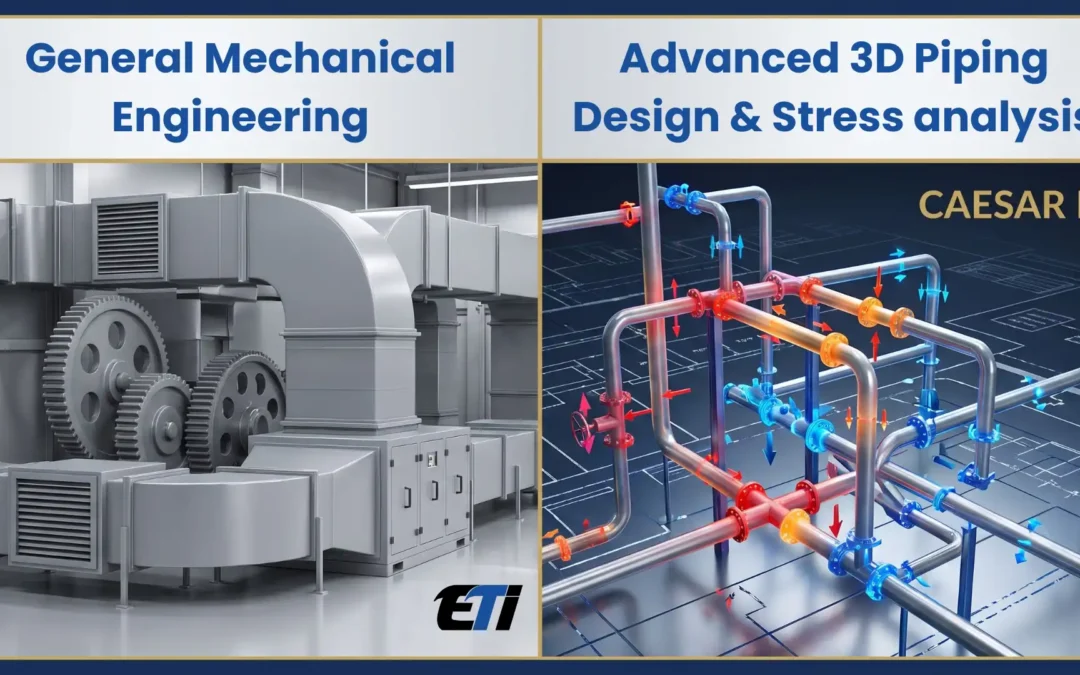
A former classmate of mine spent two years as a general mechanical design engineer, doing solid, unremarkable work on HVAC systems, before a recruiter cold-messaged her about a piping design role at an EPC firm. She almost ignored it — she’d never touched a P&ID in her life. Eighteen months later she’s running stress models in CAESAR II and earning meaningfully more than she was. That’s not a rare story. It’s close to a pattern.
This piece is for anyone standing where she was: qualified, employed, and genuinely unsure whether switching lanes into piping design is worth the disruption.
Understanding the Core Differences in Day-to-Day Responsibilities
A general mechanical engineer’s day can look like almost anything — HVAC systems, machine design, product development, thermal analysis. That breadth is the whole selling point of the degree, and it’s also why the day-to-day varies wildly from one mechanical role to the next.
A piping engineer’s day is narrower and, frankly, more concrete. It usually starts with a P&ID and ends with something that has to survive real physical conditions for decades: correct pipe routing through a congested rack, a stress model that satisfies ASME B31.3 without overloading a nozzle, an isometric drawing precise enough for a fabricator to build from without calling you twice. Corrosion allowances, welding specifications, instrumentation tie-ins — all of it has to reconcile inside one coherent design.
The honest way to put it: general mechanical engineering rewards versatility. Piping engineering rewards depth in one demanding, code-governed discipline. Neither is inherently better — they’re just different bets on what kind of career you want to build.
Analyzing the Job Market and Demand in 2026
Here’s the uncomfortable part of the comparison. General mechanical engineering postings pull enormous applicant volume, because nearly every mechanical grad qualifies for them. Piping engineering postings, by contrast, tend to sit open longer — not from lack of interest, but because the pool of people who can actually open a P&ID and route a line inside AutoCAD Plant 3D or SP3D on day one is much smaller.
That gap hasn’t closed on its own, and there’s no strong signal it’s about to.
Which Industries Are Hiring Piping Designers Right Now?
Oil & gas remains the heaviest hirer, particularly around refinery upgrades and brownfield expansions where older piping systems need re-engineering rather than replacement. Power generation is close behind — both new builds and retrofits of aging plants. Chemical and petrochemical processing rounds out the top three, driven partly by the same aging-infrastructure dynamic. Outside those three, water treatment and industrial manufacturing show steady, if smaller, demand. If you’re weighing the pivot, it’s worth checking which of these sectors is actually active in the region you want to work in — demand isn’t evenly distributed.
Salary Comparisons and Long-Term Growth Potential
Compensation data in this space is messy — it varies by region, firm size, and project cycle more than most engineering comparisons — so treat any specific number with some skepticism. But the general pattern holds up consistently across sources: specialized piping engineers tend to out-earn generalist mechanical engineers with comparable years of experience, and the gap tends to widen further once someone moves into pipe stress analysis specifically, which is the more technical, more scarce branch of the discipline.
The reasoning isn’t mysterious. Scarcity drives leverage. A generalist mechanical engineer is, by design, competing against a huge pool of similarly-qualified people. A piping engineer with real ASME code fluency and hands-on modeling experience is competing against a much smaller field — and EPC firms know it.
Key Skill Gaps You Need to Bridge to Make the Switch
If you’re coming from general mechanical engineering, here’s what actually needs building, roughly in order of how soon you’ll need it:
- P&ID interpretation — reading process intent, not just naming symbols on a diagram
- 3D modeling software — real, hands-on fluency in AutoCAD Plant 3D, SP3D, or PDMS, not a passing familiarity
- ASME B31.3 and related codes — knowing how to apply allowable stress and wall-thickness rules to an actual line, not just knowing they exist
- Pipe stress analysis — enough CAESAR II fluency to interpret a load case, not just run one
- Documentation discipline — isometric drawings and material take-offs precise enough to survive contact with a fabrication shop
None of this is covered in a standard mechanical curriculum, which is exactly why it has to be built deliberately rather than picked up passively on the job.
Is Piping Design the Right Fit for Your Engineering Style?
Not everyone should make this switch, and it’s worth being honest about that before committing time and money to it. If you’re the kind of engineer who enjoys variety — different problems, different systems, different constraints every few months — general mechanical work probably suits you better than piping’s narrower, code-heavy focus.
If, on the other hand, you get genuine satisfaction from mastering a dense rulebook and applying it precisely, if you’d rather go deep on one demanding system than broad across many, piping design tends to be a much better long-term fit. It’s also worth asking yourself how you feel about constraint-heavy work generally — piping design has less creative latitude than product design, and more direct consequence when something’s wrong.
How to Fast-Track Your Specialization with Excel Technical
Building this skill set from scratch, informally, on the job typically takes years — and a fair number of expensive mistakes along the way. A structured piping engineering course compresses that timeline considerably by pairing real modeling time with genuine ASME code application, rather than theory alone.
For engineers who want the most comprehensive path, a Master Diploma in Piping Engineering covers the full technical stack — layout, materials, documentation, and stress fundamentals — in one structured track. Those specifically targeting the stress analysis branch should look for training built directly around CAESAR II, and anyone whose primary gap is 3D modeling can close it faster with standalone training in AutoCAD or SmartPlant 3D rather than committing to a full diploma upfront.
Final Verdict: Making the Smart Choice for Your Future
There’s no universally correct answer here — my former classmate made the right call for herself, but plenty of excellent engineers stay general and do very well. What matters is making the decision deliberately rather than by accident: understanding the real day-to-day difference, the actual state of demand in your target sector, the honest skill gaps you’d need to close, and whether the work itself fits how you like to think.
If the pattern in this piece sounds like your situation — solid mechanical fundamentals, growing curiosity about a narrower, better-compensated specialty — the gap between where you are and where piping design roles need you to be is closable. It just isn’t going to close on its own.
FAQs
1. Is piping engineering actually more in-demand than general mechanical engineering in 2026? For specialized roles specifically, yes — piping engineer postings tend to stay open longer due to a smaller qualified applicant pool, even as general mechanical postings get flooded with applications.
2. Do piping engineers really earn more than general mechanical engineers? Generally, yes, though the gap varies by region and experience level. Specialization in pipe stress analysis tends to widen that gap further, since it’s a narrower, more technical branch with fewer qualified candidates.
3. Can I switch from mechanical to piping engineering without going back to school full-time? Yes — most people make this transition through a focused, hands-on piping design course rather than a new degree, since the core gap is specific technical skills (software, codes, documentation) rather than foundational engineering knowledge.
4. Which industries hire the most piping engineers right now? Oil & gas leads, driven largely by refinery upgrades, followed closely by power generation and chemical/petrochemical processing. Regional demand varies, so it’s worth checking which sectors are active where you want to work.
5. How do I know if piping design is the right specialization for me? If you prefer depth over variety — mastering a dense, code-governed system rather than working across many different problem types — piping design tends to be a strong fit. If you thrive on variety and broader creative latitude, general mechanical engineering may suit you better.