
If you’ve spent any time job-hunting with a mechanical engineering degree in your hand, you’ve probably noticed something uncomfortable: the degree that was supposed to open doors mostly gets you into a very crowded room. Everyone else in that room has the same credential. What separates the people who get hired from the people who keep applying usually comes down to something narrower and more specific — and piping design keeps showing up as the answer nobody talks about enough.
The Changing Landscape of Mechanical Engineering in 2026
Mechanical engineering as a field hasn’t shrunk — if anything, industrial activity across oil & gas, power, and chemical processing is expanding. What’s changed is who gets picked for the roles that matter. Hiring managers at EPC firms aren’t looking for someone who understands mechanics in general anymore. They’re looking for someone who can sit down with a P&ID, understand the process engineering interface between what’s designed and what actually gets built, and contribute to real project work without six months of hand-holding first.
Is that fair to new graduates? Not entirely. But it’s the market as it currently exists, not the one anyone would design from scratch.
Why a Standard Degree is No Longer Enough
A mechanical engineering degree teaches fundamentals — thermodynamics, materials science, statics and dynamics. It doesn’t teach you how to interpret piping isometric drawings, produce a usable material take-off (MTO), or apply ASME B31.3 to an actual stress calculation. Those are specialized, plant-specific skills, and they simply aren’t part of a standard four-year curriculum. So graduates walk out the door with strong theoretical grounding and almost no exposure to the piping design workflow that governs how real industrial plants get engineered, built, and commissioned. That gap doesn’t close itself. Someone either spends years absorbing it on the job, piece by piece, or goes and closes it deliberately.
What Makes Piping Design a High-Demand Niche?
Piping isn’t a side detail in plant engineering — it’s the connective tissue of the entire facility. Every vessel, pump, and piece of instrumentation is tied together through a piping system that has to handle pressure, temperature, corrosion, and structural load simultaneously, all while staying within code. A lot of moving parts for one discipline to own — which is exactly why engineers who can actually own it are hard to find.
The Boom in Global Energy, Oil & Gas, and Infrastructure Sectors
Refineries are aging and need upgrades. Power generation projects, including new and retrofitted facilities, keep getting greenlit. Oil and gas infrastructure continues to expand in multiple regions even as the broader energy mix shifts. Every one of these projects needs engineers who understand process plant design at a working level — not textbook level. Demand hasn’t slowed down; if anything, it’s outpacing the number of engineers qualified to do the work well.
Top 5 Reasons to Choose a Piping Design Course This Year
1. Higher Salary Trajectories and Global Opportunities
Specialized piping engineers tend to command better compensation than generalist mechanical engineers with comparable experience, largely because the skill set is scarcer and the work carries real consequences — a poorly designed line doesn’t just look bad on paper, it can fail in the field. That scarcity translates into leverage, both in salary negotiations and in the geographic range of where you can work, since piping engineering is one of the more globally transferable specializations in the industrial sector.
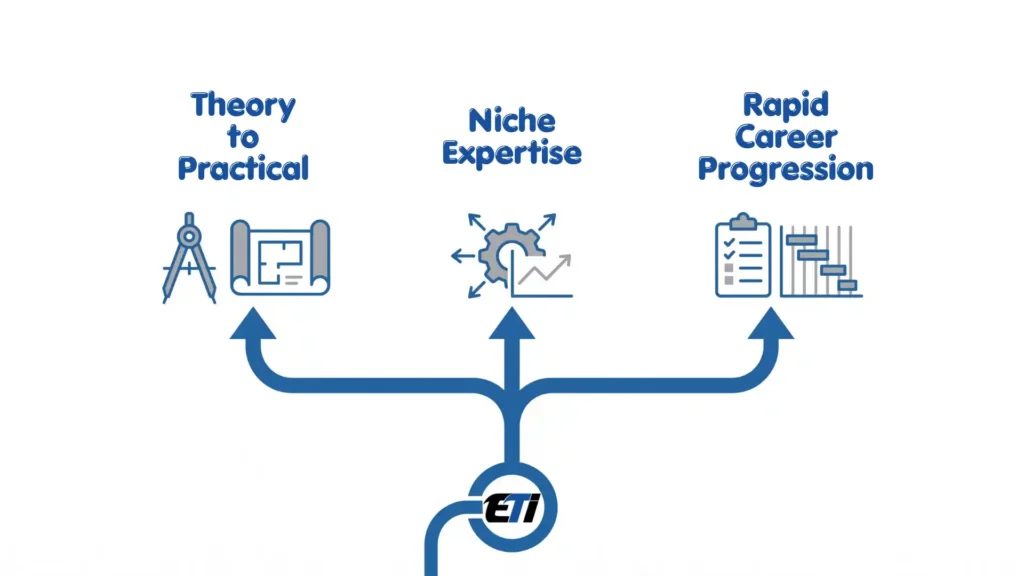
2. Transitioning from Theory to High-Value Practical Application
This one’s probably the most immediate benefit. A good piping design course puts you inside actual modeling software —Everything 3D, for instance — and has you working through piping layout design, pipe routing, and pipe support design using real project scenarios, not simplified textbook problems. You leave with something closer to hands-on project experience than a stack of lecture notes.
3. The Growing Need for Sustainable Piping Solutions
Corrosion management, material efficiency, and energy-conscious design aren’t side considerations anymore — they’re becoming central to how plants are engineered, especially as older facilities get retrofitted rather than replaced. Engineers who understand piping material engineering well enough to reduce waste, extend service life, and select materials appropriate to actual operating conditions are increasingly valuable. That’s not a trend that seems likely to reverse anytime soon.
4. Niche Expertise Equals Less Job Market Competition
Here’s the practical math: thousands of mechanical engineering graduates enter the job market every year, all competing for the same broad pool of generalist roles. Piping design pulls you out of that pool entirely and into a much smaller, less saturated one, where the competition is other specialists rather than every mechanical engineering graduate within a hundred-mile radius.
5. Rapid Career Progression into Project Management
Piping engineers who understand the full piping design lifecycle — from conceptual layout through detailed design, procurement, plant construction, and commissioning support — tend to move into project engineering and project management roles faster than engineers confined to a single narrow task. Understanding how piping interacts with instrumentation, welding requirements, and overall plant engineering standards gives you the cross-disciplinary fluency that leads to bigger responsibility down the line.
How Excel Technical Bridges the Gap from Student to Professional
A lot of piping courses out there are, frankly, mostly lecture slides — you watch, you take notes, and you come away with a certificate that doesn’t hold up well under real interview questions. Excel Technical Institute’s piping engineering course is built around actual piping design documentation practice, hands-on modeling work, and engineering calculations rooted in ASME B31.3, rather than theory alone.
For engineers who already know which direction they want to head, there’s also a PG Diploma in Piping Engineering for a more comprehensive, career-length track, a Master Diploma in Piping Engineering for those wanting the deepest possible coverage, and a Piping Draughtsman Course for anyone leaning toward documentation and drafting work specifically. There’s also standalone training in SmartPlant 3D, AVEVA E3D, and CAESAR II for engineers who want to build depth in one specific tool rather than a full program.
You can browse the full course catalog or read more about the institute’s approach on their about page before deciding what fits your situation best.
Conclusion: Future-Proof Your Engineering Career Today
None of this guarantees a job — nothing does. But if you’re a mechanical engineering graduate stuck watching applications go nowhere, piping design is one of the more direct, evidence-backed paths out of that pile. The industry needs engineers who understand process plant piping at a working level, and that gap isn’t closing on its own. Whether you specialize now or three years from now, the sooner you close it, the sooner you stop competing with everyone else who has the exact same degree you do.
FAQs
1. Is a piping design course worth it if I already have a mechanical engineering degree?
For most graduates, yes. It moves you out of a broad, oversaturated applicant pool into a narrower specialization that EPC firms and process plants are actively short-staffed on.
2. Do I need prior knowledge of ASME B31.3 before enrolling?
No. A properly structured course teaches ASME B31.3 and related piping codes from the ground up — you just need the mechanical engineering foundation you already have.
3. What software should I expect to learn in a piping design course?
Most reputable programs include hands-on training in tools like AutoCAD Plant 3D, along with exposure to piping isometric drawings, MTO preparation, and layout/routing work using real project scenarios.
4. How does piping design connect to career growth beyond entry-level roles?
Engineers who understand the full piping design lifecycle — design through construction and commissioning support — tend to move into project engineering and management roles faster than those confined to one narrow task.
5. Is piping engineering only relevant to oil and gas, or does it apply elsewhere?
It spans oil and gas, power generation, and chemical processing, and increasingly touches sustainable retrofit projects as older plants get upgraded rather than rebuilt from scratch.