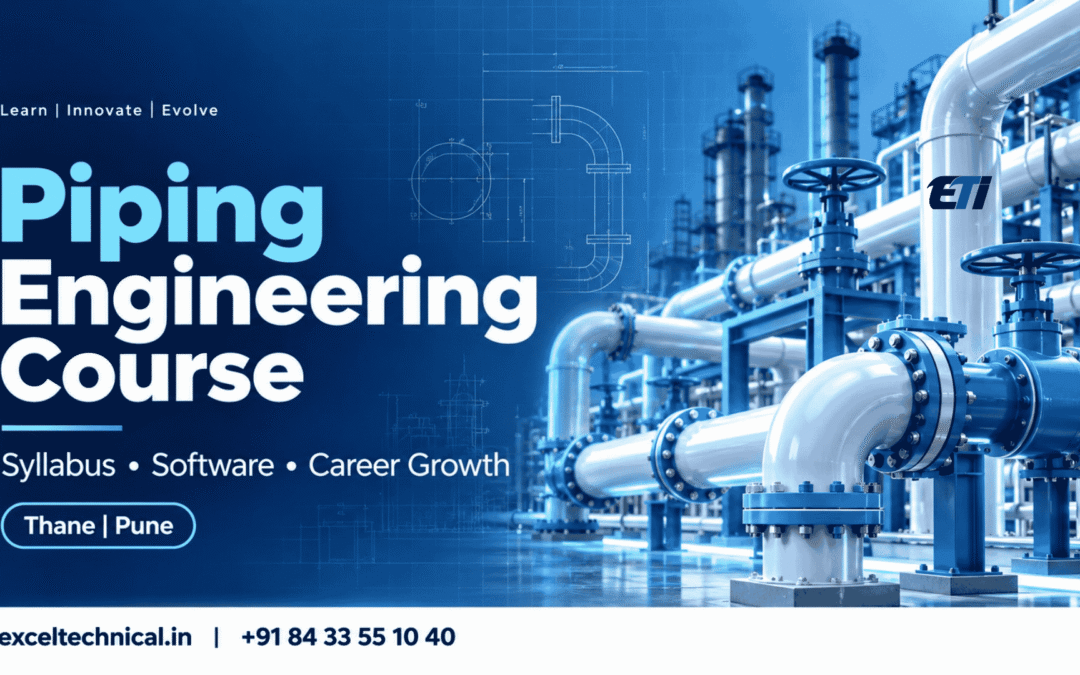
Every refinery, chemical plant and power station depends on thousands of metres of pipe, and someone has to design that network. That someone is a piping engineer. If you are a mechanical or chemical engineer wondering what to do after graduation, a piping engineering course is one of the most direct routes into the EPC and oil and gas industry.
This guide covers who can join, what you learn, which software you use, and where the career can take you.
Quick answer: A piping engineering course teaches you to read P&IDs, create piping layouts, prepare isometric drawings and select piping materials. It prepares mechanical, chemical and diploma graduates for design roles in EPC, oil and gas, petrochemical and power companies.
What Is a Piping Engineering Course?
A piping engineering course trains you in how process plant piping is designed, from the first P&ID to the final fabrication drawing. You learn the components (valves, fittings, flanges, gaskets), the logic behind routing, and the documents a project team expects from a junior designer.
The best programmes go beyond software buttons. They teach you why a pipe is routed a certain way, which is what separates a designer from a software operator.
Who Can Join a Piping Design Course?
This course suits:
- BE/BTech graduates in Mechanical, Chemical or Petroleum Engineering
- Diploma holders from a similar background
- Production or manufacturing professionals who want to move into design
- Working professionals with some plant exposure
No prior piping knowledge is needed. If you can read a basic engineering drawing, you can start. If CAD is completely new to you, a short AutoCAD course before or alongside piping training helps.
How to Become a Piping Engineer: 6 Steps
- Check your qualification. A mechanical, chemical or petroleum background is the usual entry point.
- Learn the fundamentals. Understand plant lifecycle, components and piping documentation.
- Master P&ID reading. Every design starts here.
- Practise layout and isometrics. Turn plot plans and equipment GA drawings into routed pipes.
- Build a portfolio. A real case study or capstone speaks louder than a certificate in interviews.
- Apply to EPC contractors and consultancies. Resume support and interview preparation make this step easier.
Piping Engineering Course Syllabus
ETI’s Piping Engineering course follows the order of a real design job:
| Module | What you learn |
|---|---|
| 1. Process Plant Piping Fundamentals | Plant design lifecycle, valves, fittings, flanges, gaskets, bolting |
| 2. P&ID Interpretation and Layout | ISA symbology, layouts from plot plans and GA drawings, clearance and drainage |
| 3. Piping Material Engineering | Reading and developing PMS, material selection for corrosive, high-temperature and cryogenic service, flange ratings |
| 4. Pipe Routing and Isometrics | Routing principles, isometric drawings, weld mapping, spool numbering, MTO basics |
| 5. Pipe Support Fundamentals | Support types, basic calculations, documentation for fabrication |
| 6. Workflow and Software Lab | Concept-to-issue workflow, AutoCAD and AutoCAD Plant 3D labs, capstone project |
Software You Will Learn
The course covers AutoCAD for 2D piping drawings and documentation, with an introduction to AutoCAD Plant 3D for routing and isometric extraction in a modelled environment. Labs run on ETI’s licensed workstations, so you do not need to buy anything.
Duration, Mode and Fees
- Duration: 2 months
- Mode: Classroom plus software labs
- Centres: Thane and Pune
- Batches: Evening and weekend batches are available at the Thane centre for working professionals
- Certification: ETI certificate listing the modules completed and the software trained on
For the latest fees and batch dates, download the brochure or book a free demo class.
Placement Support
ETI’s placement cell works with EPC contractors and engineering consultancies and supports you with resume preparation and interview practice for piping design roles. Your project portfolio is what proves your skill in the interview room.
Is Piping Engineering a Good Career?
Yes, for people who like engineering logic and structured design work. Piping designers are needed wherever fluids move through plants: oil and gas, petrochemicals, pharmaceuticals, power generation, water infrastructure and EPC firms.
A typical growth path looks like this (indicative ranges, which vary by company and city):
| Stage | Role | Indicative salary |
|---|---|---|
| 0-2 years | Junior Engineer | ₹2-3 lakh p.a. |
| 2-5 years | Design Engineer | ₹3-5 lakh p.a. |
| 5-8 years | Senior Engineer | ₹5-9 lakh p.a. |
| 8+ years | Lead Engineer | ₹9-13 lakh p.a. |
The trade-off is that early-career pay is modest and the first year demands real learning on projects. Those who build strong fundamentals and add 3D software or stress analysis grow fastest.
Which Course Is Best for Piping Design?
Check these before you enrol:
- A syllabus that follows a real project, not just software menus
- Hands-on labs on licensed software
- Live or anonymised project drawings for markup practice
- A capstone portfolio you can show employers
- Placement support with a track record
- A clear next step, such as the PG Diploma in Piping Engineering for those who want deeper design workflow, codes and software training
Piping Engineering Course in Thane and Pune
ETI trains students at both its Thane and Pune centres. Whether you are in Dombivli, Kalyan, Mumbai or Pimpri-Chinchwad, you can attend classes in person and see the labs before you commit.
Frequently Asked Questions
Can a diploma holder join a piping engineering course?
Yes. Diploma holders in mechanical or a related field can enrol.
Do I need to know AutoCAD first?
No. The labs start from zero.
Do I have to buy software?
No. ETI provides licensed workstations for every lab session.
Can working professionals attend?
Yes. Evening and weekend batches are available at the Thane centre.
Is placement guaranteed?
Placement support, resume help and interview preparation are provided, but the final result depends on your skills and portfolio.
Start Your Piping Career
A piping engineering course gives you what employers look for: clear fundamentals, practical drawings and project-ready documentation. Visit the Piping Engineering course page for the full syllabus, or call +91 84 33 55 10 40 to book a free demo class at ETI Thane or Pune.
Excel Technical Institute: Learn | Innovate | Evolve