
PG Diploma in Piping Engineering Course
➲ Complete workflow: PFD → P&ID → routing → codes → finished isometric — not one piece taught in isolation
➲ 4-month sequence, taught in order, not stitched together yourself later
➲ Foundation-level: built for fresh engineering and diploma graduates, no prior piping background needed
➲ Placement support built in: resume prep, interview guidance, employer connections throughout
➲ Outcome: take a piping task from process input to issued drawing, independently
Course Details
Duration
4 months
Training Mode
Classroom + Software Labs
Location
ETI Thane & Pune Centres
What You will Get?
Certification & Placement Support
Who Should Enroll
If you’ve completed a BE, B.Tech, or Diploma in Mechanical, Chemical, Petroleum, or a related engineering discipline, this is built for you. No piping background, no prior software experience needed. You just need to be able to read a basic engineering drawing and want to learn this properly, not in fragments. If you are starting with no CAD background at all, our AutoCAD course is a good short programme to complete before or alongside this diploma.
Skills You’ll Master
You’ll learn to read a process flow diagram and understand how it turns into a P&ID, then take that P&ID and an equipment layout and turn them into an actual route. You’ll get genuinely comfortable with components, valves, fittings, flanges, gaskets, and how each gets chosen for a given service. You’ll learn to read and apply Piping Material Specifications (PMS) correctly, route pipe through a properly congested plant area, and finish with isometric drawings that come with a real bill of materials, ready to hand off for fabrication.
Let's Learn, Innovate & Evolve with ETI
Detailed Curriculum
Introducation
The programme follows the same order a real job actually moves through — understanding the process first, issuing finished drawings last.
Module 1 — Process Plant Fundamentals and PFD Interpretation
- Reading a process flow diagram and understanding the logic behind it
- How a PFD becomes a P&ID
- Where piping fits into the bigger picture of a plant
Module 2 — P&ID Interpretation and Piping Design Basics
- Reading P&IDs using ISA symbology
- Line numbering, flow direction, and basic system logic
- How this work actually gets documented on a real project
Module 3 — Piping Components and Material Specification
- Pipes, fittings, flanges, valves, gaskets, bolting
- Reading and applying Piping Material Specifications (PMS)
- Choosing materials for corrosive, high-temperature, and cryogenic services
Module 4 — Piping Layout and Pipe Routing
- Building a layout from a plot plan and equipment GA drawing
- Routing pipe through both congested and open areas of a plant
- Clearance, access, and drainage — the things that quietly shape every routing call
Module 5 — Piping Isometric Drawings and Documentation
- Preparing isometric drawings from a routing layout
- Weld mapping, spool numbering, bill of materials generation
- Checking your own drawing against a QC list
Module 6 — Codes, Standards, and Software Lab
- Applying ASME B31.3 to real design decisions, not just reading it as a reference
- AutoCAD Plant 3D lab sessions applied to an actual plant scenario
- Capstone project: a complete piping package for a small process unit
Learning Methodology
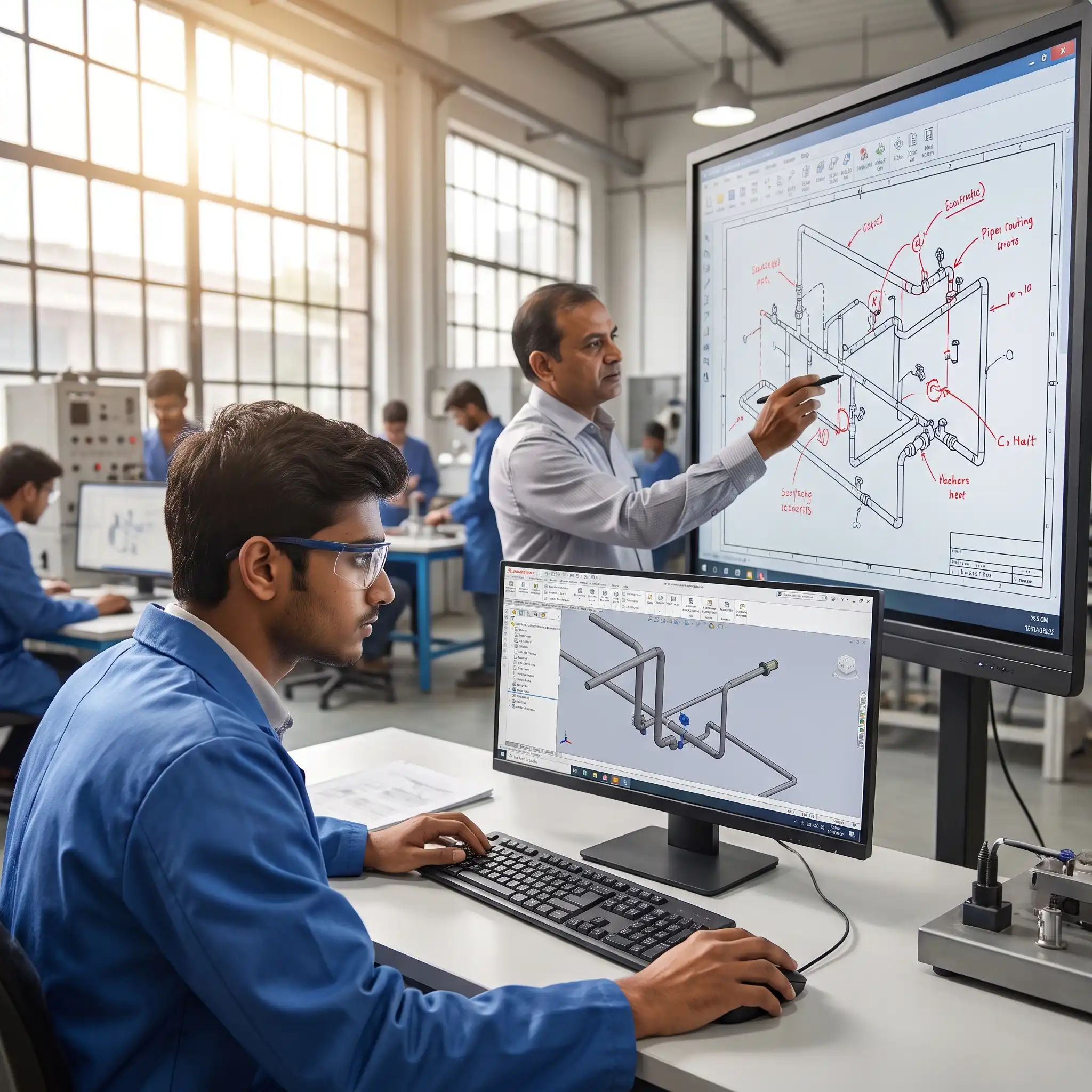
- Reasoning before execution — every module explains the engineering logic behind a decision first, so you understand why before you’re asked to apply it
- Labs run alongside theory, not after it — software practice happens on ETI’s own machines in Thane and Pune the same week a concept is introduced, not weeks later
- Real project drawings, not textbook exercises — you review anonymised drawings pulled from actual projects, not simplified examples built for a classroom
- Mark up and defend, not just observe — you identify what’s wrong in a drawing and argue your fix out loud, mirroring a real design review rather than a passive walkthrough
- Faculty with live project backgrounds — instructors teach from decisions they’ve actually made on EPC projects, not from a fixed set of course notes
Course Outcomes
By the end of the programme, you’ll be able to interpret PFDs and P&IDs, develop piping layouts, prepare piping isometric drawings, apply ASME B31.3 requirements, and produce engineering deliverables suitable for fabrication. That’s really the whole point of this diploma. Plenty of people who’ve done a shorter course can draft a layout. Fewer can be handed a whole package and trusted with it end to end. This is built to get you into that second group.
Software Covered
You’ll learn AutoCAD for 2D drawings and documentation, plus a solid introduction to Plant 3D for routing and generating piping isometric drawings from a 3D model. Every lab runs on ETI’s own licensed machines in Thane and Pune, so there’s nothing for you to install or pay for separately. If you’ve never opened either tool before, that’s fine. The labs start from zero and build up alongside the theory.
Looking to go deeper into 3D plant design after this programme? Our Smart Plant 3D training covers the full modelling workflow used on large-scale EPC projects.
Hands-on Projects & Portfolio
Midway through, you’ll work a case study covering a full process section — a PFD, a P&ID, and equipment GA drawings — and turn it into a layout and two isometrics. Your capstone takes that further: a complete package with layout, isometrics, a bill of materials, and a line list, checked against the same standard a piping engineer’s work gets held to on a real job.
Industries Hiring Piping Designers
Graduates of this programme work across every sector that builds or operates process plant engineering facilities
Oil and gas - upstream wellhead facilities, midstream pipelines, downstream refineries
Petrochemical and specialty chemical plants
Pharmaceutical manufacturing and API production units
Power generation - thermal, combined cycle, and captive power plants
Water and wastewater treatment infrastructure projects
Fertiliser and agrochemical process facilities
Career Growth Roadmap
Entry Level (0–2 Years)
Role: Junior Piping Engineer
Salary: ₹3.0L–₹5.5L p.a.
Career Progression (2–5 Years)
Role: Piping Design Engineer
Salary: ₹5.5L–₹9L p.a.
Leadership Stage (5–8 Years)
Role: Senior Piping Engineer
Salary: ₹9L–₹14L p.a.
Advanced Career Path (8+ Years)
Role: Lead Piping Engineer
Salary: ₹14L–₹20L p.a.
Certification Details
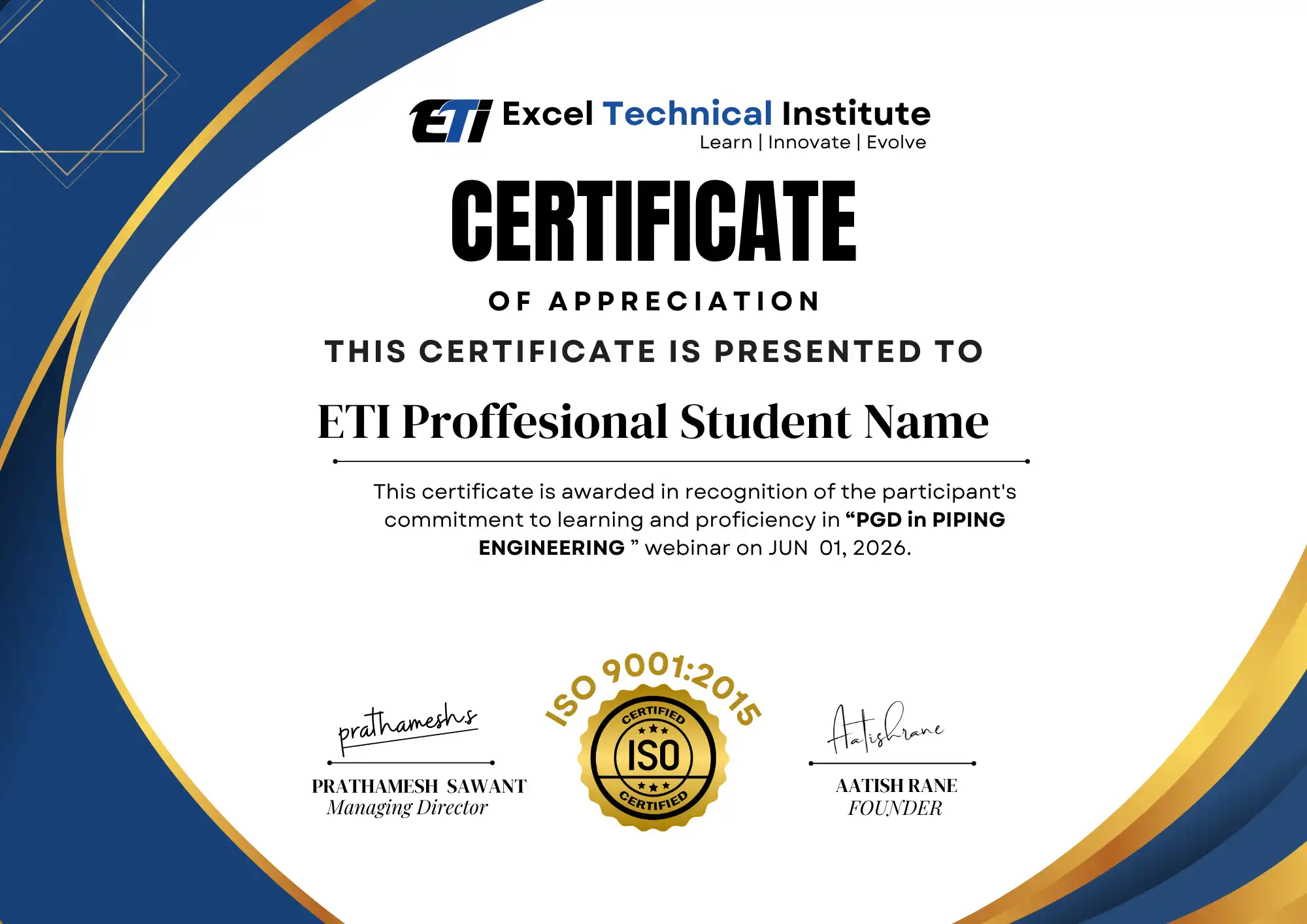
On completion, you get the ETI certificate for this diploma, listing the modules you’ve done, the codes you studied, and the software you trained on. More importantly, your capstone project demonstrates your ability to produce real piping engineering deliverables, giving employers practical evidence of your skills. It mirrors exactly what a real project deliverable looks like, and that’s what an employer actually wants to see.
Frequently Asked Questions
Is this suitable for a fresh graduate with no piping background?
Yes, that’s exactly who this is for. No prior piping or software experience is assumed anywhere in the syllabus. Every module starts from first principles before moving into applied design work.
Does this diploma include placement support?
Yes, it’s built into the programme. ETI’s placement cell works with EPC contractors and consultancies across Mumbai, Thane, Navi Mumbai, and Pune, along with resume help and interview prep.
How is this different from a shorter piping course?
Shorter courses usually cover one or two stages. This one covers the whole sequence, process understanding through to isometrics, over four months, so you come out with a complete foundation instead of a partial one.
Do you run this in both Thane and Pune?
Yes, same curriculum, same lab setup, same licensed software at both centres. Pick whichever’s easier to get to.
Will I learn to read a Process Flow Diagram as well as a P&ID?
Yes, Module 1 covers PFD interpretation directly, including how it turns into a P&ID, before the programme moves into detailed P&ID work and piping design.
Ready to Start?
Seats for the next batch are open now at our Thane and Pune centres.
📲 WhatsApp us to check your eligibility
📄 Download the brochure for the full syllabus, fees, and placement details
📞 Book a free demo class before you commit
🗓 Talk to a course advisor about your background and fit