
Master Diploma in Piping Engineering
➲ Advanced-level progression: built for engineers with entry-level piping training or 1-2 years of on-the-job experience
➲ Deep-dive curriculum: master stress fundamentals, 3D modelling, and real project engineering workflows
➲ Detailed engineering focus: transition past basic layout work directly into complex, detailed engineering roles
➲ Placement support built in: career guidance and employer connections integrated into the core programme, not bolted on at the end
➲ Outcome: execute advanced piping engineering tasks independently, trained on-site at ETI’s Thane centre
Course Details
Duration
3 months
Training Mode
Classroom + Software Labs
Location
ETI Thane & Pune Centres
What You will Get?
Certification & Placement Support
Who Should Enroll
This programme suits engineers who’ve completed a foundational piping or mechanical course and want to move into detailed engineering, or working professionals with a year or two of layout experience looking to add stress fundamentals and 3D modelling to their skill set. If you already know what a P&ID is and want to go past it, you’re the right fit here.
If you are just starting out with no piping background, our PG Diploma in Piping Engineering is the right first step before joining this programme.
Skills You’ll Master
You’ll take a piping layout from concept to a fully coordinated 3D model, run clash detection before it ever reaches a review meeting, and build isometrics that survive a real design review. You’ll also learn to size pipe supports properly, read stress fundamentals well enough to flag a problem before it becomes a stress engineer’s problem, and coordinate your piping design against structural, civil, and instrumentation inputs the way a real project demands.
Let's Learn, Innovate & Evolve with ETI
Detailed Curriculum
Introducation
The programme is structured around how a piping package actually moves through detailed engineering, from layout to issued-for-construction documentation.
Module 1 — Advanced Piping Layout and Plant 3D Modelling
- Building a piping layout directly in a 3D model environment
- Equipment, structure, and pipe rack coordination
- Model-based design versus 2D-first design
Module 2 — Pipe Routing and Clash Detection
- Routing logic for congested plant areas
- Running clash detection and resolving conflicts before issue
- Coordinating pipe routing with structural and electrical layouts
Module 3 — Piping Material Specification and Material Take-Off
- Developing and applying a Piping Material Specification (PMS) at project scale
- Producing an accurate Material Take-Off (MTO) from the 3D model
- Linking specification decisions to procurement timelines
Module 4 — Stress Analysis Fundamentals
- Why certain routing decisions create stress problems downstream
- Reading a basic stress report and understanding what it’s flagging
- Pipe support placement and selection based on stress considerations
Module 5 — Pipe Support Design
- Support types and where each is applied
- Load calculations for support sizing
- Documenting supports for fabrication
Module 6 — Piping Isometric Drawings and Documentation
- Applying ASME B31.3 to real design decisions, not just reading it as a reference
- AutoCAD Plant 3D lab sessions applied to an actual plant scenario
- Capstone project: a complete piping package for a small process unit
Module 7 — P&ID Interpretation and Design Review
- Advanced P&ID interpretation for detailed engineering
- Preparing for and running a piping design review
- Common review comments and how to close them out
Module 8 — Project Engineering and EPC Project Workflow
- How piping fits into the broader EPC project workflow
- Multi-disciplinary coordination across structural, civil, and instrumentation
- Capstone project: a complete detailed engineering piping package
Learning Methodology
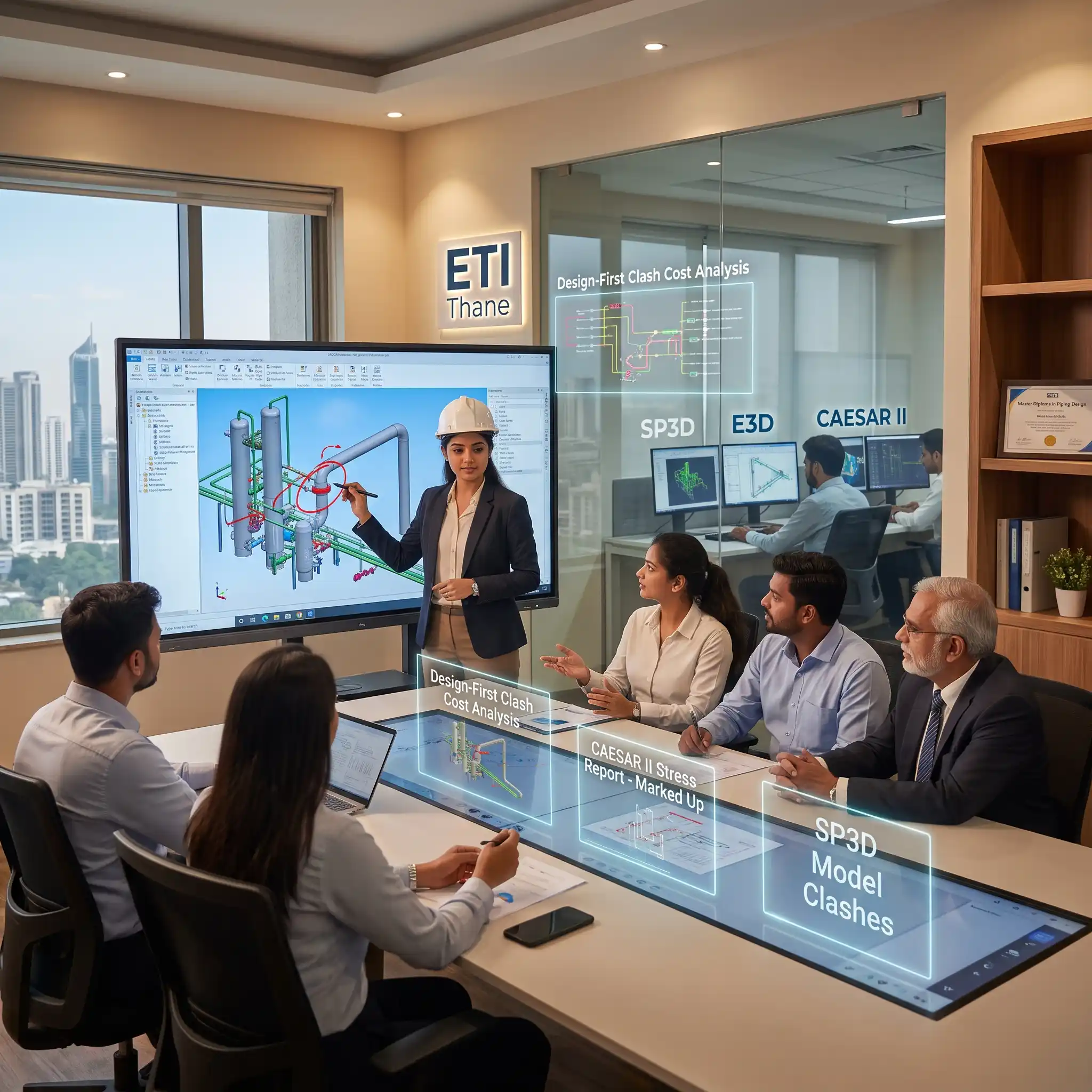
- Design-First Learning: Understand what a piping stress issue or clash actually costs before preventing it.
- Live 3D Modelling Labs: Every theory session runs parallel with hands-on SP3D, E3D, and CAESAR II labs.
- Real Project Design Reviews: Raise comments, defend positions, revise drawings — exactly how EPC projects run.
- Industry-Mapped Curriculum: Each module mirrors real piping engineering workflows used by top EPC companies.
- Job-Ready from Day One: Graduate with the technical confidence and review experience employers actually hire for.
Course Outcomes
By the end, you’re producing documentation at the level expected in detailed engineering — not just a routing sketch, but a complete piping design package: material take-offs, PMS-driven specifications, pipe support drawings, and isometrics ready for fabrication. This is the gap between someone who can draw a pipe and someone a project manager trusts with a package.
Software Covered
The programme centres on Plant 3D modelling for pipe routing, equipment placement, and clash detection, alongside AutoCAD for 2D documentation and support drawings. You’ll also get hands-on exposure to how a 3D model is used in a live multi-disciplinary environment — where structural steel, cable trays, and ductwork all compete for the same space, and your model has to account for that. No prior 3D modelling experience is assumed; it’s built up module by module.
Hands-on Projects & Portfolio
You’ll work a live-style detailed engineering case study through the middle modules, producing a routed 3D model, an MTO, and a set of isometrics for a process unit. Your capstone extends this into a full documentation package — layout, supports, isometrics, and a mock design review — reflecting what a project engineer would actually hand off at the end of a detailed engineering phase.
Industries Hiring Piping Designers
Graduates of this programme work across every sector that builds or operates process plant engineering facilities
Oil & Gas companies hire piping engineers for detailed engineering roles.
Petrochemical plants seek candidates skilled in 3D modelling and coordination.
Pharmaceutical sector demands piping engineers for GMP-compliant plant design.
Power sector EPCs recruit for project engineering and stress analysis roles.
EPC contractors specifically hire candidates experienced in multi-disciplinary coordination.
Engineering consultancies prefer graduates comfortable beyond basic 2D layout work.
Career Growth Roadmap
Entry Level (0–2 Years)
Role: Junior Piping Engineer
Salary: ₹3.0L–₹5.5L p.a.
Career Progression (2–5 Years)
Role: Piping Design Engineer
Salary: ₹5.5L–₹9L p.a.
Leadership Stage (5–8 Years)
Role: Senior Piping Engineer
Salary: ₹9L–₹14L p.a.
Advanced Career Path (8+ Years)
Role: Lead Piping Engineer
Salary: ₹14L–₹20L p.a.
Certification Details
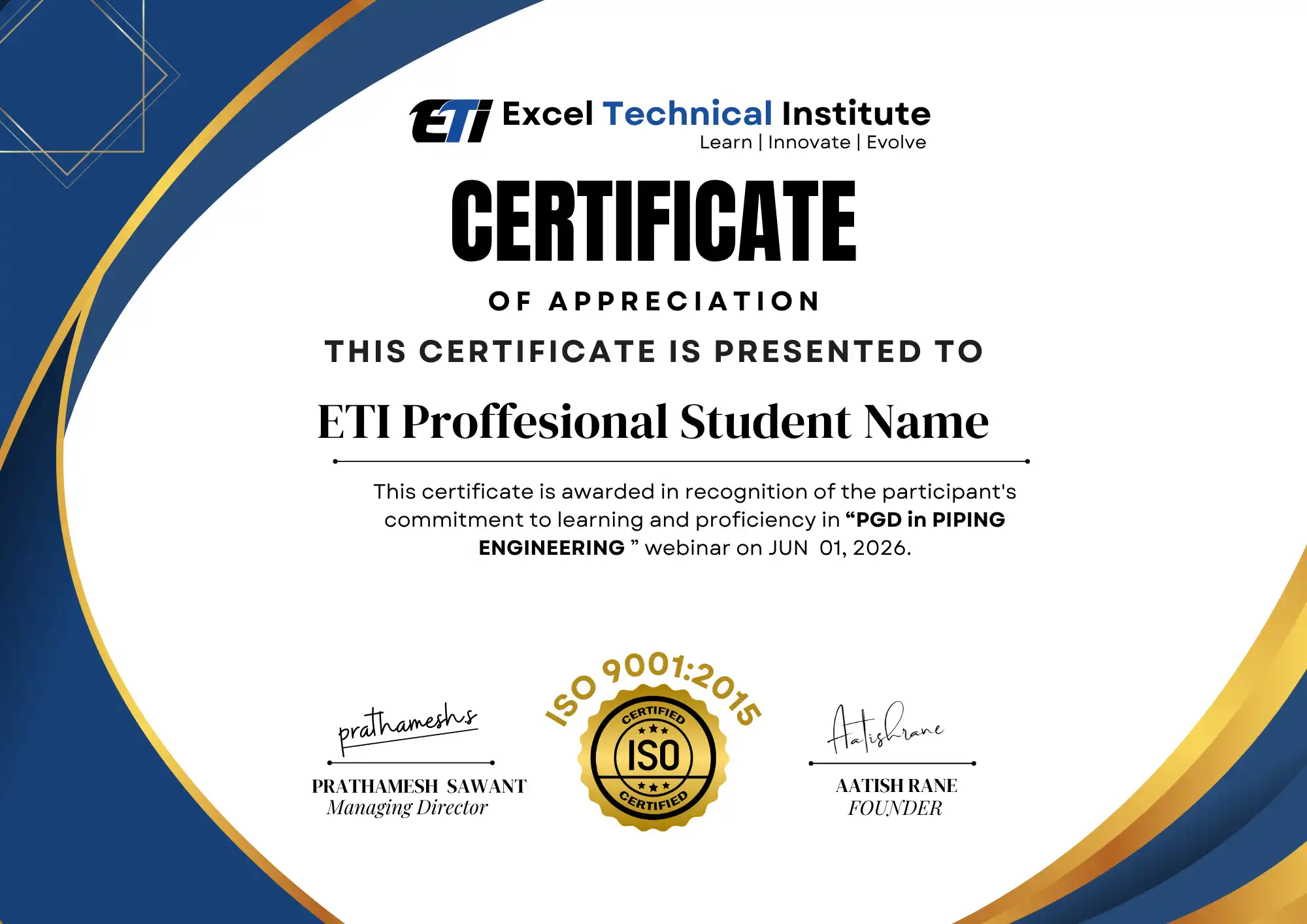
You’ll receive the ETI certificate for the Master Diploma in Piping Engineering, listing the modules completed, ASME B31.3 application, and the software you’ve trained on. Placement support is included as part of the programme, with resume review and interview preparation aimed specifically at detailed engineering and project engineering roles. As with any technical hire, the certificate opens the conversation. Your project package is what closes it.
Frequently Asked Questions
Do I need prior piping experience to join this Master Diploma in Piping Engineering?
Yes, you need a foundational piping or mechanical background, either from an entry-level piping course or a year or two of on-the-job layout experience. This programme builds on basics you already have. It’s not designed as a first introduction to piping design or plant terminology.
Is 3D modelling experience required before starting?
No, prior 3D modelling experience isn’t assumed. Plant 3D is taught module by module alongside the theory, starting from routing basics and building up to full clash detection and multi-disciplinary coordination. By the capstone, you’re modelling independently at a project-ready level.
How is this different from a foundational piping design course?
A foundational course covers routing, isometrics, and basic layout. This advanced piping engineering course adds stress fundamentals, pipe support design, 3D modelling, clash detection, and project engineering workflow, the skills that separate layout work from detailed engineering responsibility.
Does this programme include placement support?
Yes, placement support is built into the programme itself, not offered separately. You get resume review, interview preparation, and direct referrals aimed specifically at detailed engineering and project engineering roles across EPC contractors and consultancies.
Will I learn stress analysis in depth in this programme?
This programme covers stress analysis fundamentals: enough to read a stress report, understand routing implications, and select supports correctly. Full stress analysis specialisation is typically pursued afterward through our dedicated Caesar II pipe stress analysis course.
Ready to Start?
Seats for the next batch of the Master Diploma in Piping Engineering are open now at our Thane centre.
📲 WhatsApp us to check your eligibility
📄 Download the brochure for the full syllabus, fees, and placement details
📞 Book a free demo class before you commit
🗓 Request a counselling call to see if this is your next step